Tour du Valat
Tour du Valat
  • Navigation access
  • Content access
  • Footer access
  • Adopt a flamingo
  • Documentary portal
  • Search
  • fr
  • en
  • The Tour du Valat
    • History and values
    • The estate
    • Our team
    • Organisation chart and CVs
    • Governance and budget
    • Partners and sponsors
    • Visiting the Tour du Valat
  • Mediterranean wetlands
    • Types of Mediterranean wetlands
    • Threats, issues and protection
    • Spotlight on the Camargue
    • The Mediterranean Alliance for Wetlands
    • The Mediterranean Wetlands Observatory
  • Our actions
  • Media
    • The Library
    • Recent publications
    • Activity reports
    • The HAL portal
    • Books, booklets and reports
    • Institutionnal documents
    • Photo gallery
    • Videos
  • News
  • Our products
    • Agroecological products
    • Adopt a Flamingo
  • Navigation access
  • Content access
  • Footer access
  • Adopt a flamingo
  • Documentary portal
  • Search
  • fr
  • en
Tour du Valat
  • The Tour du Valat
    • History and values
    • The estate
    • Our team
    • Organisation chart and CVs
    • Governance and budget
    • Partners and sponsors
    • Visiting the Tour du Valat
  • Mediterranean wetlands
    • Types of Mediterranean wetlands
    • Threats, issues and protection
    • Spotlight on the Camargue
    • The Mediterranean Alliance for Wetlands
    • The Mediterranean Wetlands Observatory
  • Our actions
  • Media
    • The Library
    • Recent publications
    • Activity reports
    • The HAL portal
    • Books, booklets and reports
    • Institutionnal documents
    • Photo gallery
    • Videos
  • News
  • Our products
    • Agroecological products
    • Adopt a Flamingo
Research institute for the conservation of Mediterranean wetlands
  • Home
  • News
  • Projects
  • Lake Chad: New Scientific Study Reveals One of Africa’s Largest Concentrations of Waterbirds
Back to News
  • A- Switch to smaller font size
  • A+ Switch to biggest font size
  • Print
  • Share
  • RSS
Projects Publications Chad • Published on 1 July 2026

Lake Chad: New Scientific Study Reveals One of Africa’s Largest Concentrations of Waterbirds

The new scientific study, “Monitoring major biodiversity stronghold in war zones: model predicts Lake Chad remains Africa’s most important wetland for waterbirds”, published in PNAS, estimates that Lake Chad supports nearly 2.5 million waterbirds, making it one of the most important wetlands for birdlife in Africa. Conducted in a region affected by insecurity, the research also suggests that some conflict zones may unexpectedly serve as refuges for biodiversity.

Lake Chad is often associated with the security, humanitarian, and climate challenges facing the region. However, a new international study highlights another reality: an exceptional ecosystem that continues to support remarkable biodiversity despite more than a decade of conflict.

Using aerial surveys conducted under rigorous scientific protocols and advanced spatial modelling techniques, researchers from Tour du Valat and the French Biodiversity Agency (Office Français de la Biodiversité – OFB), in partnership with the NGO Wings for Conservation and Chad’s Department of Wildlife and Protected Areas, produced the first comprehensive estimates of Lake Chad’s waterbird populations since 2008.

The results are striking: approximately 2.48 million waterbirds are estimated to use the site, making it likely the largest concentration of wetland birds on the African continent.

An Unexpected Refuge for Wildlife

Contrary to common assumptions, researchers found that some species have maintained or even increased their populations in recent years. Several conflict-affected areas even showed higher animal densities than more accessible sectors.

This pattern may be explained by a “refuge effect”. Reduced human activities—including fishing, grazing, and hunting—may have created favourable conditions for wildlife.

However, the researchers caution that these encouraging findings should not obscure a more nuanced reality. While some species appear to be benefiting from current conditions, others are experiencing worrying declines, highlighting the vulnerability of this globally important ecosystem and the need for continued monitoring and conservation efforts.

Is Biodiversity Monitoring Possible in Conflict Zones?

Historically, Lake Chad was widely recognised as a major site for migratory waterbirds, comparable to the Inner Niger Delta in Mali. However, due to conflict and the resulting security challenges, scientific monitoring—including the International Waterbird Census, which tracks population sizes and trends—has not been conducted regularly since the 2000s.

Without ecological data from these key sites, estimating the size and trends of bird populations becomes extremely difficult.

“By combining adapted aerial sampling methods with spatial modelling, we were able to estimate wildlife abundance across vast and difficult-to-access territories while limiting risks to observers,” explains Pierre Defos du Rau, one of the study’s authors.
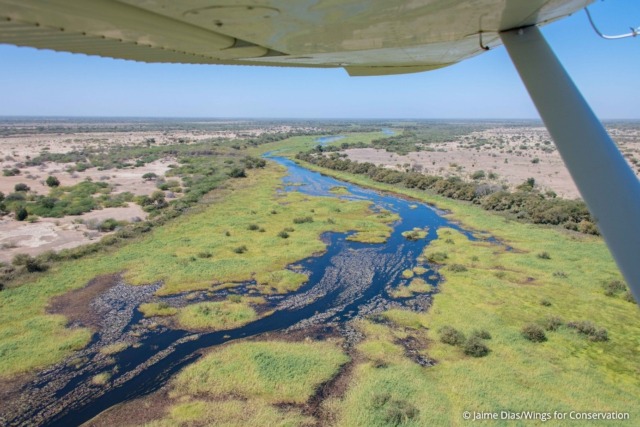
 

Aerial wildlife survey adapted to the scale of Lake Chad – © Jaime Dias / Wings for Conservation

A Global Challenge for Biodiversity and Food Security

Lake Chad plays a crucial role for migratory birds travelling annually between Africa, Europe, and Asia. Conserving this wetland is therefore an international responsibility.

Beyond its ecological importance, the site also supports local livelihoods. Waterbirds and the resources associated with wetland ecosystems contribute directly to the food security of many communities living around the lake.
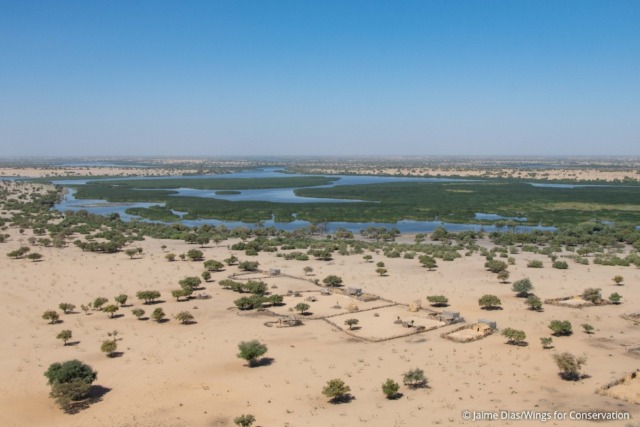
Settlement clusters on the shores of Lake Chad – aerial photographs taken during the 2022 survey © Jaime Dias / Wings for Conservation

A Call for Stronger International Protection

In light of these findings, the researchers call for strengthened protection of Lake Chad through the creation of a large-scale protected area and the inscription of the site on the UNESCO World Heritage List.

Scientific monitoring of this kind is essential for understanding changes in wildlife populations and informing future conservation strategies.

At a time when wetlands are disappearing worldwide at an alarming rate, Lake Chad stands out as a natural heritage site of exceptional global importance, whose preservation is vital both for biodiversity and for local communities.


Publication reference:

Defos du Rau P., Godeau U., Carenton N., Dias J., Wachoum A.S., Trolliet B., Baddour K., Chaibo A., Morin G.P., Portier B., Suet M., Tormos T., Mondain-Monval J.-Y., Deschamps C. 2026. Monitoring major biodiversity stronghold in war zones: Model predicts Lake Chad remains Africa’s most important wetland for waterbirds. Proceedings of the National Academy of Sciences 123:e2603538123. doi: 10.1073/pnas.2603538123

Contact:

Clémence Deschamps, Project Manager, Tour du Valat, [email protected]
Agenda

June 29 - July 3, 2026

21st Conference of the Society of Wetland Scientists
Events • Europe
All events

Newsletter

Keep up with Tour du Valat news:
Show previous newsletters
News Archives
  • 2026
  • 2025
  • 2024
  • 2023
  • 2022
  • 2021
  • 2020
  • 2019
  • 2018
  • 2017
  • 2016
  • 2015
  • 2014
  • 2013
Agenda Archives
  • 2026
  • 2025
  • 2024
  • 2023
  • 2022
  • 2021
  • 2020
  • 2019
  • 2018
  • 2017
  • 2016
  • 2015

Related
projects

All projects
Ongoing project
Science-Society Interfaces

Conservation status of biodiversity in the Mediterranean Basin

Mediterranean • 2016
Ongoing project
Management and restoration of Natural and Agricultural ecosystems

Adaptative Management of the Lagoons and Marshes on the former Camargue Saltworks site

Camargue, France • 2012
Ongoing project
Science-Society Interfaces

Mediterranean Waterbird Network (MWN)

Albania, Algeria, Camargue, Egypt, France, Greece, Italia, Libya, Macedonia, Mediterranean, Morocco, Portugal, Spain, Tunisia, Turkey • 2012
Ongoing project
Species Conservation

Eurasian Spoonbill population dynamics

Camargue, Mediterranean • 2008
Tour du Valat
Tour du Valat

Le Sambuc - 13200 Arles
France

Phone : +33 (0)4 90 97 20 13

[email protected]


Contact
  • Practical information
    • Calendar
    • Past events
    • Vacancies
    • Interactive map
    • Logo & access map
  • Legal information
    • Legal notice
    • Cookie policy (EU)
  • Linkedin
  • Facebook
  • Vimeo
  • RSS
Gérer le consentement aux cookies
We use cookies to enhance your experience on our web site.
Functional Always active
The technical storage or access is strictly necessary for the legitimate purpose of enabling the use of a specific service explicitly requested by the subscriber or user, or for the sole purpose of carrying out the transmission of a communication over an electronic communications network.
Settings
Le stockage ou l’accès technique est nécessaire dans la finalité d’intérêt légitime de stocker des préférences qui ne sont pas demandées par l’abonné ou l’utilisateur.
Statistics
The technical storage or access that is used exclusively for statistical purposes. Le stockage ou l’accès technique qui est utilisé exclusivement dans des finalités statistiques anonymes. En l’absence d’une assignation à comparaître, d’une conformité volontaire de la part de votre fournisseur d’accès à internet ou d’enregistrements supplémentaires provenant d’une tierce partie, les informations stockées ou extraites à cette seule fin ne peuvent généralement pas être utilisées pour vous identifier.
Marketing
The technical storage or access is required to create user profiles to send advertising, or to track the user on a website or across several websites for similar marketing purposes.
  • Manage options
  • Manage services
  • Manage {vendor_count} vendors
  • Read more about these purposes
See settings
  • {title}
  • {title}
  • {title}