In 2026, the monitoring of European pond turtle populations in the Tour du Valat estate begins its thirtieth year!
An annual monitoring programme since 1997
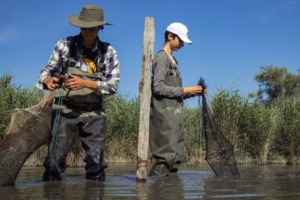
Every morning, from May to July, Alana Bell puts on her waders and makes her way to the marshes and canals of the Tour du Valat estate, in search of European pond turtles. This small black turtle with yellow markings is the only species of freshwater turtle native to a large part of Europe. Unfortunately, this species is now under threat: the destruction and degradation of wetlands – its natural habitat – are the main causes of its decline.
To better protect this species, the Tour du Valat launched, in 1997, a programme to monitor European pond turtle populations across its estate. Thirty years on, this programme is still ongoing and has provided valuable insights into the species as a whole.
“At the Tour du Valat, this long-term individual monitoring programme is the second longest-running, after the one on flamingos. And, across Europe, it is the oldest Capture-Mark-Recapture programme dedicated to European pond turtles that is still ongoing! ” according to Anthony Olivier, the research engineer leading this project at the Tour du Valat
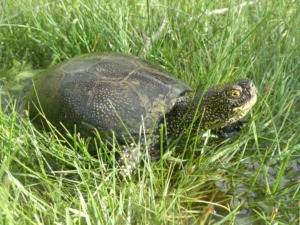 A veteran among the European pond turtlesAlthough the scientific monitoring programme began in 1997, the first markings of individual turtles at the Tour du Valat were carried out by Alan Johnson in 1976. These early efforts have proved valuable, as during recent surveys, European pond turtles tagged fifty years ago have been found alive. This is the case with European pond turtle No. 14, tagged in 1976. Now over 50 years old, this female is, to our knowledge, the oldest known individual of the species living in the wild. |
Thirty years of data: a unique perspective
These thirty years of continuous monitoring have enabled us to gather a substantial dataset, and thus to document numerous biological parameters about the species that were previously little known or unknown, such as the survival rate of adults and juveniles, the slow ageing process of this species, as well as the dispersal frequency of adult males.
However, the study of European pond turtles provides insights not only into the species itself : its longevity and highly sedentary nature make it a ‘sentinel’ species, capable of reflecting the variations occurring in its aquatic environment. For instance, articles based on Leslie-Anne Merleau’s PhD thesis have demonstrated the multi-contamination of these European pond turtle populations in the Tour du Valat Reserve by trace elements (heavy metals), pesticide residues and organic pollutants (PCBs, phthalates, PAHs) present in the waters of the Camargue’s water channels and marshes.
Learning on the field
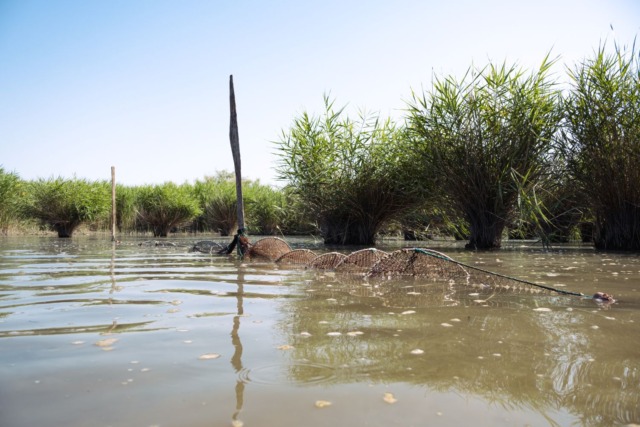
The continuity of this unique monitoring programme owes much to the commitment of young researchers, students and volunteers from the Civic Service programme and/or the European Solidarity Corps. Each year, a lead volunteer conducts fieldwork under the supervision of Anthony Olivier. Since 1997, dozens of young people have taken part in these campaigns, helping to collect data on the 1,722 European pond turtles tagged to date on the Tour du Valat estate.
For many, this experience marks their first immersion in scientific fieldwork. They learn to observe, to collect data rigorously, and to interact with wild animals whilst minimising disturbance as much as possible. Beyond the technical skills, a holistic approach is being passed on: one that encompasses scientific protocols, the patience required to observe living creatures, and the responsibility that comes with accessing preserved natural areas such as nature reserves.
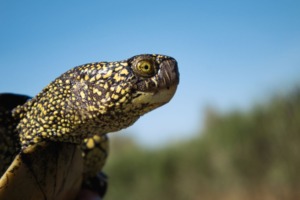
“During the year I spent at the Tour du Valat, monitoring European pond turtles was my biggest field project. Thanks to Anthony’s mentorship, I was able to discover a side of the scientific world I hadn’t known before. It was wonderful to get to know this species up close, day after day. I was thrilled to contribute to this project, and particularly to be able to observe individuals such as European pond turtle number 14, which was identified fifty years ago.”
Testimonial from Alana Bell, a volunteer with the European Solidarity Corps (ESC)
DWatch a video about the European pond turtle monitoring programme, produced by students at the MoPA school (in French):