In the cool, clear waters of the upper Soča basin, a preserved region of Slovenia, lives the peaceful marble trout Salmo marmoratus, a species endemic to the Adriatic basin. This species almost disappeared from the Soča due to hybridisation with the common trout Salmo trutta. The latter was regularly stocked, i.e. released, until a conservation plan was put in place by the Tour du Valat, the Tolmin fishing association and the WWF in the 1990s.
Separated by impassable physical barriers (waterfalls), only a few genetically pure populations (nine, including two created artificially) have survived to this day, upstream of this basin. But for how many more years?

More than 25 years of monitoring
In order to better understand the impact of climate change on aquatic ecosystems, and more specifically on the different species of trout found in the region — marble trout (Salmo marmoratus) and brown trout (Salmo trutta) — scientists have been monitoring the temperature of several rivers in the upper Soča basin in Slovenia for over 25 years.
Through this long-term, multi-site monitoring, they compiled a detailed overview of the thermal conditions of the three main rivers – the Soča, Bača and Idrijca – as well as several smaller upstream watercourses. They then analysed temperature changes over time and examined the possible consequences for the two trout species.
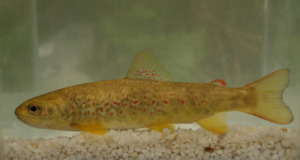 Marbled trout, a species sensitive to water warmingThe marble trout (Salmo marmoratus) is a species endemic to the Adriatic basin, found only in certain rivers in Slovenia and Italy. Like all salmonids, it is stenothermic: it tolerates only slight variations in temperature and needs cold, oxygenated water to survive. |

Results confirm the warming of waters
Based on the monitoring of 25 sites, analysis of data collected between 1996 and 2022 reveals a clear trend: waters are warming (+0.04°C/year), especially in summer, with an average increase of 0.1°C per year at 19 sites. Although temperatures currently remain favourable for salmonid reproduction and growth, periods when the water exceeds 15°C, the critical threshold for brown trout, are becoming increasingly frequent.

“The optimal temperature range for brown trout and common trout is between 5°C and 15°C.”
- A hydrobiological context that exacerbates the phenomenon: in addition to the gradual rise in temperatures, there is also a decrease in flow rates in summer. This makes streams more sensitive to local heat.
- Extreme events make populations vulnerable: beyond temperature, scientists emphasise that the intensification of extreme events such as flash floods and droughts further complicate the lives of salmonids.
The importance of long-term monitoring
This study highlights the importance of long-term monitoring across multiple sites in order to anticipate and target sensitive aquatic habitats for protection. It serves as a reminder that rivers, even in mountainous and preserved regions, are not immune to the effects of climate change. Understanding, monitoring and preserving these habitats, limiting human interventions that increase seasonal warming, and protecting refuge areas are essential to ensuring the future of marble trout and river ecosystems.
Contact
Delphine Nicolas, Research Officer, Tour du Valat
Publication reference
Nicolas D., Testi B., Jesenšek D., Leban K., Crivelli A.J. 2025. Effects of the global change on the thermal habitat quality for Salmonids within the Upper Soča watershed in Slovenia. Ecohydrology & Hydrobiology:100705. doi: 10.1016/j.ecohyd.2025.100705