
Tour du Valat
Tour du Valat
  • Navigation access
  • Content access
  • Footer access
  • Adopt a flamingo
  • Documentary portal
  • Search
  • fr
  • en
  • The Tour du Valat
    • History and values
    • The estate
    • Our team
    • Organisation chart and CVs
    • Governance and budget
    • Partners and sponsors
    • Visiting the Tour du Valat
  • Mediterranean wetlands
    • Types of Mediterranean wetlands
    • Threats, issues and protection
    • Spotlight on the Camargue
    • The Mediterranean Alliance for Wetlands
    • The Mediterranean Wetlands Observatory
  • Our actions
  • Media
    • The Library
    • Recent publications
    • Activity reports
    • The HAL portal
    • Books, booklets and reports
    • Institutionnal documents
    • Photo gallery
    • Videos
  • News
  • Our products
    • Agroecological products
    • Adopt a Flamingo
  • Navigation access
  • Content access
  • Footer access
  • Adopt a flamingo
  • Documentary portal
  • Search
  • fr
  • en
Tour du Valat
  • The Tour du Valat
    • History and values
    • The estate
    • Our team
    • Organisation chart and CVs
    • Governance and budget
    • Partners and sponsors
    • Visiting the Tour du Valat
  • Mediterranean wetlands
    • Types of Mediterranean wetlands
    • Threats, issues and protection
    • Spotlight on the Camargue
    • The Mediterranean Alliance for Wetlands
    • The Mediterranean Wetlands Observatory
  • Our actions
  • Media
    • The Library
    • Recent publications
    • Activity reports
    • The HAL portal
    • Books, booklets and reports
    • Institutionnal documents
    • Photo gallery
    • Videos
  • News
  • Our products
    • Agroecological products
    • Adopt a Flamingo
Research institute for the conservation of Mediterranean wetlands
  • Home
  • News
  • Publications
  • Evidence for a relationship between bird body size and uncertainty in individual morphological measurements at ringing
Back to News
  • A- Switch to smaller font size
  • A+ Switch to biggest font size
  • Print
  • Share
  • RSS
Publications Camargue, France • Published on 10 July 2026

Evidence for a relationship between bird body size and uncertainty in individual morphological measurements at ringing

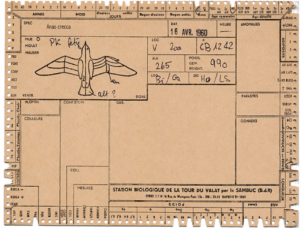
A ringing form used in the 1960s to record the morphometric data of ringed birds.

For several decades, bird ringing programmes have been a key source of data for the study of bird populations . These programmes are used, notably, to monitor population dynamics, the physical condition of individuals and the responses of species to environmental changes such as climate change. The reliability of the morphometric measurements collected during these programmes is therefore a significant issue.

A recent study, based on historical data collected at the Tour du Valat between 1952 and 1978, highlights the existence of operator-related inaccuracies (arising from the person taking the measurement) in morphometric measurements carried out as part of long-term ringing programmes. It analyses the extent of these inaccuracies according to the size of the species concerned and the morphological characteristics measured.


Generally robust measurements of wing length
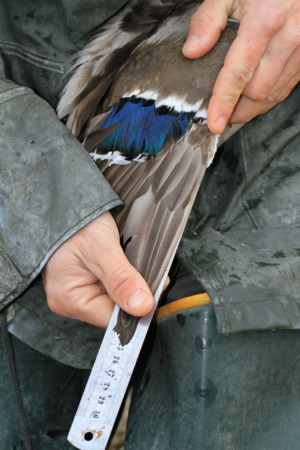
Measuring the length of a mallard’s wing © Y. Thonnerieux

The analysis covers 17,818 individuals belonging to 14 bird species, for which three morphometric parameters were examined: wing length, body mass and a body condition index.

The results show that wing length exhibits low variability between ringers, with a deviation from the mean of less than 1% of the total measurement. This measurement therefore appears to be robust overall, even in a context involving numerous ringers and surveys carried out over a long period.

Greater variability in body mass and body condition index

In contrast, greater differences between operators are observed for body mass, with variations of up to 10% of the total measurement. The body condition index, calculated from body mass and wing length, shows similar results, directly reflecting this variability.

These variations show that certain measurements are influenced by species characteristics, the equipment used (such as dynamometers), and the specific practices of each operator.

Greater effects in larger species

The study also shows that larger species (such as Mallard ducks) are proportionally more affected by these variations in measurement. This finding suggests that the size of the individuals is a key factor in the extent of the discrepancies observed between operators.

A key challenge for the analysis of long-term datasets

These findings highlight the importance of taking observer-related effects into account when analysing long-term ringing data. They suggest that particular attention should be paid to the measurement of morphological characteristics, especially in larger species.

Beyond this observation, this study helps to improve documentation of the sources of variability in field data, which is essential for enhancing the accuracy of ecological analyses based on long-term monitoring.


Publication reference:

Martinais, Y., Gaget, E., Guillemain, M., & Francesiaz, C. (2026). Evidence for a relationship between bird body size and uncertainty in individual morphological measurements at ringing. Bird Study, 1–13. https://doi.org/10.1080/00063657.2026.2686446 

Contact :

Elie Gaget, Tour du Valat, France

Newsletter

Keep up with Tour du Valat news:
Show previous newsletters
News Archives
  • 2026
  • 2025
  • 2024
  • 2023
  • 2022
  • 2021
  • 2020
  • 2019
  • 2018
  • 2017
  • 2016
  • 2015
  • 2014
  • 2013
Agenda Archives
  • 2026
  • 2025
  • 2024
  • 2023
  • 2022
  • 2021
  • 2020
  • 2019
  • 2018
  • 2017
  • 2016
  • 2015
Tour du Valat
Tour du Valat

Le Sambuc - 13200 Arles
France

Phone : +33 (0)4 90 97 20 13

[email protected]


Contact
  • Practical information
    • Calendar
    • Past events
    • Vacancies
    • Interactive map
    • Logo & access map
  • Legal information
    • Legal notice
    • Cookie policy (EU)
  • Linkedin
  • Facebook
  • Vimeo
  • RSS
Gérer le consentement aux cookies
We use cookies to enhance your experience on our web site.
Functional Always active
The technical storage or access is strictly necessary for the legitimate purpose of enabling the use of a specific service explicitly requested by the subscriber or user, or for the sole purpose of carrying out the transmission of a communication over an electronic communications network.
Settings
Le stockage ou l’accès technique est nécessaire dans la finalité d’intérêt légitime de stocker des préférences qui ne sont pas demandées par l’abonné ou l’utilisateur.
Statistics
The technical storage or access that is used exclusively for statistical purposes. Le stockage ou l’accès technique qui est utilisé exclusivement dans des finalités statistiques anonymes. En l’absence d’une assignation à comparaître, d’une conformité volontaire de la part de votre fournisseur d’accès à internet ou d’enregistrements supplémentaires provenant d’une tierce partie, les informations stockées ou extraites à cette seule fin ne peuvent généralement pas être utilisées pour vous identifier.
Marketing
The technical storage or access is required to create user profiles to send advertising, or to track the user on a website or across several websites for similar marketing purposes.
  • Manage options
  • Manage services
  • Manage {vendor_count} vendors
  • Read more about these purposes
See settings
  • {title}
  • {title}
  • {title}