Recent studies conducted in Corsican coastal lagoons show how phytoplankton dynamics evolve over the long term and highlight the joint—yet hierarchical—role of nutrient inputs and climatic conditions.
Coastal lagoons: ecosystems monitored over time
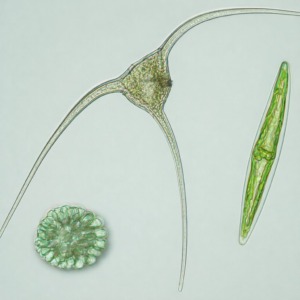
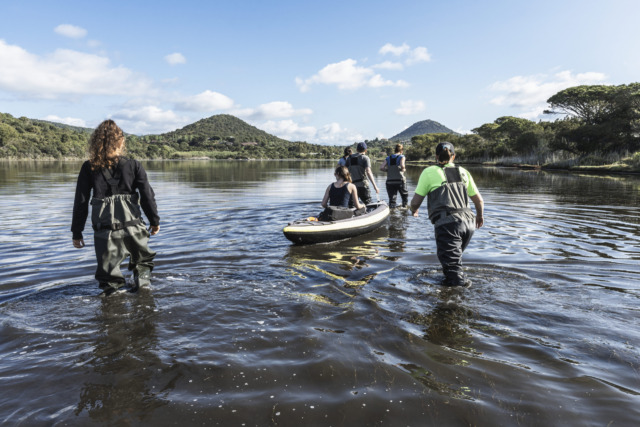
The study is based on a summer monitoring programme carried out over the past 17 years in four lagoons located on the eastern coastal plain of Corsica, within the framework of the European Water Framework Directive (WFD). Each year, several parameters are measured, including water temperature, salinity, nutrient concentrations (nitrogen and phosphorus), as well as various phytoplankton indicators (chlorophyll-a, abundance by size class, and pigment composition).
The scientists’ objective was to better understand how climatic variations (air temperature, rainfall and wind) and nutrient inputs influence long-term phytoplankton trends, which form the basis of the aquatic food web.
Different responses according to the trophic status of lagoons
The results show that the functioning and evolution of lagoons strongly depend on their exposure to nutrients.
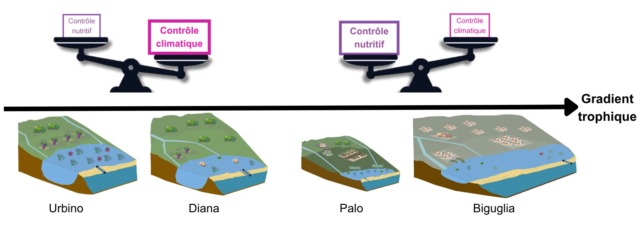
In the most nutrient-enriched lagoons, phytoplankton dynamics are mainly determined by nutrient inputs, which lead to significant biomass peaks and promote the dominance of diatoms. In these eutrophic systems, climatic effects appear secondary and difficult to isolate.
Conversely, in nutrient-poor lagoons, the effects of climatic variations (warming, rainfall events and wind events) become more perceptible. Although their impact remains lower compared with that of nutrient inputs, climatic conditions influence phytoplankton composition: wind events stimulate biomass and favour large-sized organisms, whereas high temperatures favour small cyanobacteria adapted to warm, nutrient-poor waters.
Climate and nutrients: two drivers to be considered jointly
This study highlights that lagoons do not respond uniformly to environmental change. Phytoplankton trajectories are primarily controlled by trophic status, while climatic effects are expressed with varying intensity depending on the exposure of systems to nutrients.
The authors remind us that, in eutrophic systems, reducing nutrient inputs remains the priority and has already been identified in several studies as an essential restoration lever. However, they now stress the need to also integrate the coupled effects of climate into management strategies.
In the most preserved lagoons, low nutrient exposure promotes more stable functioning and provides an opportunity to detect climatic signals at an early stage, making these systems true “sentinels” of environmental change.
Ecosystems particularly sensitive to global change
In all cases, coastal lagoons appear particularly vulnerable to future changes, including rising temperatures, more frequent extreme events, reduced freshwater inputs, sea-level rise and changes in salinity.
In this context, the long-term monitoring of these environments is essential to anticipate their future trajectories, guide management actions and preserve the services they provide, including coastal protection, carbon storage, biodiversity, fisheries and shellfish farming.
Publication reference:
Moulin, A., Bec, B., Boutron, O., Derolez, V., Garrido, M., Pasqualini, V., Malet, N.,2026. Climatic and nutrient drivers affect long-term phytoplankton temporal trends in coastal lagoons. Marine Pollution Bulletin, 224, 119080. https://doi.org/10.1016/j.marpolbul.2025.119080
Contacts:
- Aurore MOULIN | University of Corsica, CNRS UMR 6134 SPE, ‘Water Management in the Mediterranean’ project: [email protected]
- Olivier BOUTRON | Directeur de recherche – Coordinateur du thème Dynamiques des zones humides et gestion de l’eau
Learn more:
Derolez, V., Bec, B., Munaron, D., Fiandrino, A., Pete, R., Simier, M., Souchu, P., Laugier, T., Aliaume, C., Malet, N., 2019. Recovery trajectories following the reduction of urban nutrient inputs along the eutrophication gradient in French Mediterranean lagoons. Ocean & Coastal Management 171, 1–10. https://doi.org/10.1016/j.ocecoaman.2019.01.012
Ligorini, V., Garrido, M., Malet, N., Simon, L., Alonso, L., Bastien, R., Aiello, A., Cecchi, P., Pasqualini, V., 2023. Response of Phytoplankton Communities to Variation in Salinity in a Small Mediterranean Coastal Lagoon: Future Management and Foreseen Climate Change Consequences. Water 15, 3214. https://doi.org/10.3390/w15183214
Pesce, M., Critto, A., Torresan, S., Giubilato, E., Santini, M., Zirino, A., Ouyang, W., Marcomini, A., 2018. Modelling climate change impacts on nutrients and primary production in coastal waters. Science of The Total Environment 628–629, 919–937. https://doi.org/10.1016/j.scitotenv.2018.02.131
Funders:
- ANR22-EXES-0016
- PhD thesis co-funded 50% by the University of Corsica and 50% by IFREMER