
Tour du Valat
Tour du Valat
  • Navigation access
  • Content access
  • Footer access
  • Adopt a flamingo
  • Documentary portal
  • Search
  • fr
  • en
  • The Tour du Valat
    • History and values
    • The estate
    • Our team
    • Organisation chart and CVs
    • Governance and budget
    • Partners and sponsors
    • Visiting the Tour du Valat
  • Mediterranean wetlands
    • Types of Mediterranean wetlands
    • Threats, issues and protection
    • Spotlight on the Camargue
    • The Mediterranean Alliance for Wetlands
    • The Mediterranean Wetlands Observatory
  • Our actions
  • Media
    • The Library
    • Recent publications
    • Activity reports
    • The HAL portal
    • Books, booklets and reports
    • Institutionnal documents
    • Photo gallery
    • Videos
  • News
  • Our products
    • Agroecological products
    • Adopt a Flamingo
  • Navigation access
  • Content access
  • Footer access
  • Adopt a flamingo
  • Documentary portal
  • Search
  • fr
  • en
Tour du Valat
  • The Tour du Valat
    • History and values
    • The estate
    • Our team
    • Organisation chart and CVs
    • Governance and budget
    • Partners and sponsors
    • Visiting the Tour du Valat
  • Mediterranean wetlands
    • Types of Mediterranean wetlands
    • Threats, issues and protection
    • Spotlight on the Camargue
    • The Mediterranean Alliance for Wetlands
    • The Mediterranean Wetlands Observatory
  • Our actions
  • Media
    • The Library
    • Recent publications
    • Activity reports
    • The HAL portal
    • Books, booklets and reports
    • Institutionnal documents
    • Photo gallery
    • Videos
  • News
  • Our products
    • Agroecological products
    • Adopt a Flamingo
Research institute for the conservation of Mediterranean wetlands
  • Home
  • News
  • Media
  • Birds change altitude to survive epic journeys across deserts and seas
Back to News
  • A- Switch to smaller font size
  • A+ Switch to biggest font size
  • Print
  • Share
  • RSS
Media Publications Africa, Mediterranean • Published on 20 February 2026

Birds change altitude to survive epic journeys across deserts and seas

Great-reed warbler, a migratory bird that frequently flies above 2,000 metres to cross the Sahara Desert © Marc Thibault

Every year, billions of birds undertake extraordinary migrations, crossing vast deserts and open seas with no place to stop, feed, or rest. A new international study published in iScience by a consortium of researchers from Tour du Valat, CEFE/CNRS, Muséum national d’Histoire naturelle and Swiss Ornithological Institute reveals that small migratory birds adjust how high they fly over these ecological barriers, and that their strategies depend on wing morphology and plumage color.

Using miniature multi-sensor tracking devices, researchers tracked 17 species of small migratory birds as they crossed two major barriers on their journey between Europe and sub-Saharan Africa: the Sahara Desert and large marine areas such as the Mediterranean Sea and the Bay of Biscay.
The results show striking differences in flight behavior.


Flying high over the Sahara, low over the sea

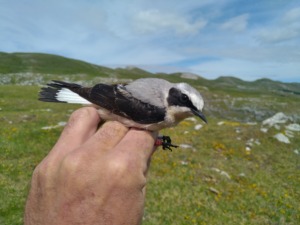
Northern Wheatear Oenanthe oenanthe equipped with a miniature multiple sensor (light, pressure, bird activity)  logger on its back © Stéphan Tillo / Tour du Valat

When crossing the Sahara Desert, birds typically flew at much higher altitudes than over the sea, often reaching 2,500 to 4,000 meters above sea level, especially during daytime. In contrast, sea crossings usually occurred at much lower altitudes, sometimes probably just a few dozen meters above the water surface.
According to Jocelyn Champagnon, a senior researcher at Tour du Valat and co-last author of the study, «These small birds fly almost exclusively at night, but they sometimes extend their night flights into the following day when crossing the desert. When the sun rises, we have found that they fly higher. This behaviour probably helps them avoid overheating by reaching cooler air at higher altitudes. Conversely, when crossing the seas, they descend, which puts them at risk of colliding with future offshore wind developments.»


Wing size and color matter

The study shows that physical traits help explain why species fly at different heights:

  • Birds with larger wings tended to fly higher, likely because larger wing area provides more lift in thinner air.
  • Darker-plumaged species flew higher during daytime desert crossings, probably to reduce heat absorbed from solar radiation.
  • Species with shorter wing bones also flew higher during daytime flights, suggesting they  may rely more on cooler air at altitude to dissipate heat during long journeys. In contrast,  species with longer wing bones have a larger and more vascularised wing surface, which  likely allows more efficient heat dissipation and better tolerance of high temperatures without
    needing to climb as high.

Together, these results demonstrate that migration strategies are closely linked to anatomy
and thermal constraints.

Unexpected low-altitude sea flights

Over marine barriers, some species, particularly the Northern Wheatear, frequently flew extremely close to the sea surface, sometimes spending most of the crossing below 50  meters in altitude.

Flying low may reduce energy costs by exploiting calmer winds near the surface or  aerodynamic effects close to the water, although further research will be needed to fully  understand the benefits of this strategy.

Why are these results important?

Long distance migratory birds are declining. Ecological barriers such as deserts and seas represent some of the most dangerous stages of bird migration. The study highlights how finely tuned these crossing strategies are, and how sensitive they may be to environmental change.

The findings have implications for wind energy development in marine environments. Many migratory birds cross seas at low altitudes, sometimes flying close to the water surface, which may bring them into the range of offshore wind turbines during long-distance flights. Understanding when, where, and how high birds fly over marine areas can help improve the planning and operation of wind farms, reducing collision risks.

This study was funded by the Migralion (2021-2025) and Migratlane (2022-2027) French programmes, initiated in the context of offshore wind power development, to address the critical lack of data on seabirds and migratory birds, particularly in the Gulf of Lion and the Bay of Biscay, and the urgent need to acquire accurate knowledge about these species.


Press Contacts

Coralie Hermeloup – Responsable communication – [email protected] – 04 90 97 28 70
Jocelyn Champagnon – Directeur de recherche – [email protected] – 04 90 97 06 80


Publication reference

Dufour, P. et al. (2026). Ecological barrier crossing strategies in small migratory birds depend on wing morphology and plumage color. iScience, 29, 114466. https://doi.org/10.1016/j.isci.2025.11446

Agenda

March 19, 2026 at 10:00h

Webinaire – The Mediterranean Wetland Outlook 3 and the Mediterranean Wetlands Geoportal
Seminars • Mediterranean
All events

Newsletter

Keep up with Tour du Valat news:
Show previous newsletters
News Archives
  • 2026
  • 2025
  • 2024
  • 2023
  • 2022
  • 2021
  • 2020
  • 2019
  • 2018
  • 2017
  • 2016
  • 2015
  • 2014
  • 2013
Agenda Archives
  • 2024
  • 2023
  • 2022
  • 2021
  • 2020
  • 2019
  • 2018
  • 2017
  • 2016
  • 2015
  • 2014
  • 2013
Tour du Valat
Tour du Valat

Le Sambuc - 13200 Arles
France

Phone : +33 (0)4 90 97 20 13

[email protected]


Contact
  • Practical information
    • Calendar
    • Past events
    • Vacancies
    • Interactive map
    • Logo & access map
  • Legal information
    • Legal notice
    • Cookie policy (EU)
  • Linkedin
  • Facebook
  • Vimeo
  • RSS
Gérer le consentement aux cookies
We use cookies to enhance your experience on our web site.
Functional Always active
The technical storage or access is strictly necessary for the legitimate purpose of enabling the use of a specific service explicitly requested by the subscriber or user, or for the sole purpose of carrying out the transmission of a communication over an electronic communications network.
Settings
Le stockage ou l’accès technique est nécessaire dans la finalité d’intérêt légitime de stocker des préférences qui ne sont pas demandées par l’abonné ou l’utilisateur.
Statistics
The technical storage or access that is used exclusively for statistical purposes. Le stockage ou l’accès technique qui est utilisé exclusivement dans des finalités statistiques anonymes. En l’absence d’une assignation à comparaître, d’une conformité volontaire de la part de votre fournisseur d’accès à internet ou d’enregistrements supplémentaires provenant d’une tierce partie, les informations stockées ou extraites à cette seule fin ne peuvent généralement pas être utilisées pour vous identifier.
Marketing
The technical storage or access is required to create user profiles to send advertising, or to track the user on a website or across several websites for similar marketing purposes.
Manage options Manage services Manage {vendor_count} vendors Read more about these purposes
See settings
{title} {title} {title}