Tour du Valat
Tour du Valat
  • Navigation access
  • Content access
  • Footer access
  • Adopt a flamingo
  • Documentary portal
  • Search
  • fr
  • en
  • The Tour du Valat
    • History and values
    • The estate
    • Our team
    • Organisation chart and CVs
    • Governance and budget
    • Partners and sponsors
    • Visiting the Tour du Valat
  • Mediterranean wetlands
    • Types of Mediterranean wetlands
    • Threats, issues and protection
    • Spotlight on the Camargue
    • The Mediterranean Alliance for Wetlands
    • The Mediterranean Wetlands Observatory
  • Our actions
  • Media
    • The Library
    • Recent publications
    • Activity reports
    • The HAL portal
    • Books, booklets and reports
    • Institutionnal documents
    • Photo gallery
    • Videos
  • News
  • Our products
    • Agroecological products
    • Adopt a Flamingo
  • Navigation access
  • Content access
  • Footer access
  • Adopt a flamingo
  • Documentary portal
  • Search
  • fr
  • en
Tour du Valat
  • The Tour du Valat
    • History and values
    • The estate
    • Our team
    • Organisation chart and CVs
    • Governance and budget
    • Partners and sponsors
    • Visiting the Tour du Valat
  • Mediterranean wetlands
    • Types of Mediterranean wetlands
    • Threats, issues and protection
    • Spotlight on the Camargue
    • The Mediterranean Alliance for Wetlands
    • The Mediterranean Wetlands Observatory
  • Our actions
  • Media
    • The Library
    • Recent publications
    • Activity reports
    • The HAL portal
    • Books, booklets and reports
    • Institutionnal documents
    • Photo gallery
    • Videos
  • News
  • Our products
    • Agroecological products
    • Adopt a Flamingo
Research institute for the conservation of Mediterranean wetlands
  • Home
  • News
  • Projects
  • A look back at two years of data collection on bats and wetlands
Back to News
  • A- Switch to smaller font size
  • A+ Switch to biggest font size
  • Print
  • Share
  • RSS
Projects Camargue, France • Published on 23 December 2025

A look back at two years of data collection on bats and wetlands

As the second year of the Rest-Chir’Eau project comes to a close, we look back on two years of data collection on bats and wetlands, carried out through two field campaigns.
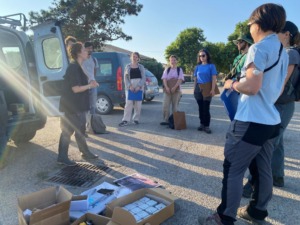
Knowledge transfer prior to a participatory monitoring session. © Rest-Chir’Eau © Rest-Chir'Eau

Since late 2024, the Rest-Chir’Eau project has been studying bat activity in the Canal du Japon area, formerly known as the Bras de Fer du Rhône, in Camargue.

The aim of this study is to use bats as a bioindicator species to assess the functionality of wetlands and the Trame Turquoise* (a network of wetlands and waterways) and, ultimately, to propose a restoration plan for this area of the former Bras de Fer in Camargue, involving the various stakeholders in the region. By studying chiropteran activity in these environment, we can gain essential information about hydrological functioning, the quality and use of habitats, and ecological continuity.   

Focus on an innovative monitoring protocol

Over the past two years, several actions were implemented to reinforce our knowledge.

The first phase of the project aimed to improve understanding of the close links between bats and wetlands. To this end, an experimental monitoring protocol was deployed in seven marshes located along the former Bras de Fer du Rhône river during four key periods of the year.

This field campaign was an ambitious challenge, as it required taking into account significant constraints while adhering to a rigorous experimental protocol. To date, this challenge  has been successfully accomplished, providing  a large set of environmental and biotic data in addition to the passive recording of bat activity.

This success was made possible  by putting in place adaptive and creative solutions. The support of local partners and stakeholders (owners, users, volunteers, etc.) was also crucial, and we are very grateful to them!

We now have a dataset that is being analyzed. Here are some figures that we have so far:

  • more than 40% of the sites were located on private land
  • 1,790 environmental data points from 135 sampling events (Site x Point x Night) were collected
  • 119,893 sounds of bat activity with 15,343,394 calls and 310,537 buzzes (specific sound signature identifying insect capture) were recorded
  • 8,218 invertebrates were identified and grouped into 88 families, 121 plant species and more than 13 vegetation traits were identified

Investing in a major participatory science programme: a first that gives wings!

Mapping of monitoring points recorded as part of the 2025 participatory science campaign © Rest-Chir’Eau © Rest-Chir'Eau

The second part of the project aims to model and test the functionality of the Turquoise Network associated with these marshes in the former Bras de Fer area. To achieve this, a large-scale participatory science programme was rolled out in the field during 2025, with an interactive survey to find potential sites and implement the participatory monitoring.

Four monitoring sessions were organised with the aim of documenting bat movements along the former Bras de Fer during these keys periods. Thanks to the remarkable mobilisation of more than 130 volunteers, surveys were carried out at 79 monitoring points throughout the sessions, 15 additional sites were monitored.

This data has also been processed and integrated into our database and is now ready to be incorporated.

Part 2 of the project in figures:

  • 482 sound recordings were processed
  • 482 field reports were completed by participants
  • 4,466 individual bats were observed
  • 1 complete cartographic database (Excel and GIS) was compiled
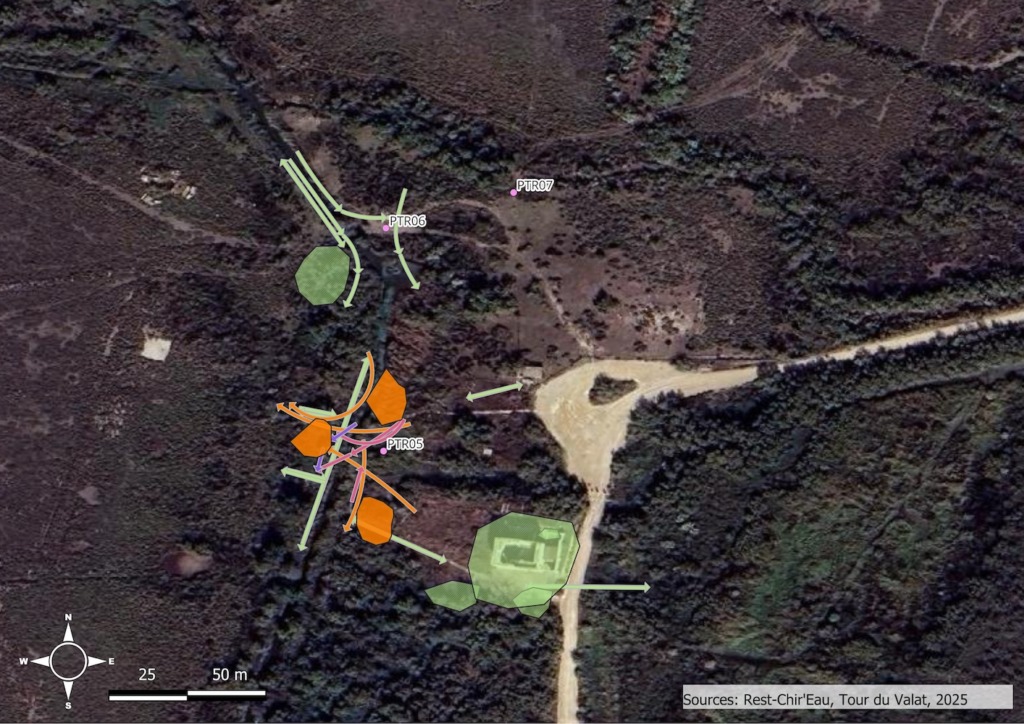
Example of cartographic data collected in one of the monitoring areas. © Rest-Chir’Eau © Rest-Chir'Eau


Positive feedback in terms of integration and participation

Beyond the figures, the momentum generated by the project’s various participatory science campaigns has helped to achieve one of the project’s underlying objectives: to promote ownership and integration of the project and its issues within the Camargue region.

Synergies with local partners and stakeholders have thus made it possible to gather additional and sometimes surprising knowledge.

Mobilisation around participatory monitoring has enabled the appropriation and sharing of knowledge related to the project, as well as the transfer of expertise in monitoring protocols and the identification of bats without disturbing them.  The result? Wonderful moments of sharing and collective knowledge production, acclaimed by all participants.

The success of these two follow-up initiatives would not have been possible without the involvement of numerous stakeholders: we would like to extend our warmest thanks to all the volunteers who participated, the landowners (and users) who granted access to their land, as well as the ASCO du Canal du Japon and Syndicat Mixte de gestion des associations syndicales du Pays d’Arles, whose support was invaluable in gaining access to certain areas along the canal in the second phase, and the technical partners who provided assistance during the monitoring, such as Camargue Regional Nature Park, Camargue National Nature Reserve and the CPIE Rhône-Pays d’Arles.

The coming months will be devoted to analysing and modelling data collected, with the aim of proposing a restoration plan that could be used to reinforce the turquoise network in the Camargue.
Stay connected to find out what happens next by subscribing to the project newsletter!

For further

Links

  • Subscribe to the project newsletter
Agenda

March 19, 2026 at 10:00h

Webinaire – The Mediterranean Wetland Outlook 3 and the Mediterranean Wetlands Geoportal
Seminars • Mediterranean

April 25 - April 26, 2026

Weekend at the Tour du Valat agroecological farm – From Farm to Farm Festival 2026
Events • Camargue, France

May 13 - May 17, 2026

The Tour du Valat at the Camargue Festival 2026
Events • Camargue, France
All events

Newsletter

Keep up with Tour du Valat news:
Show previous newsletters
News Archives
  • 2026
  • 2025
  • 2024
  • 2023
  • 2022
  • 2021
  • 2020
  • 2019
  • 2018
  • 2017
  • 2016
  • 2015
  • 2014
  • 2013
Agenda Archives
  • 2024
  • 2023
  • 2022
  • 2021
  • 2020
  • 2019
  • 2018
  • 2017
  • 2016
  • 2015
  • 2014
  • 2013

Related
projects

All projects
Ongoing project
Dynamics and management of Hydrosystems and Coastal Areas

Hydrological system modelling

Camargue, France • 2015
Ongoing project
Transversal projects

Dragonfly and Damselfly Conservation

Camargue, France • 2014
Ongoing project
Species Conservation

Monitoring passerines in the Camargue

Camargue, France • 2015
Ongoing project
Species Conservation

Technical Support Unit for the AEWA African initiative

Africa, Algeria, Egypt, Libya, Mediterranean, Morocco, Tunisia • 2012
Tour du Valat
Tour du Valat

Le Sambuc - 13200 Arles
France

Phone : +33 (0)4 90 97 20 13

[email protected]


Contact
  • Practical information
    • Calendar
    • Past events
    • Vacancies
    • Interactive map
    • Logo & access map
  • Legal information
    • Legal notice
    • Cookie policy (EU)
  • Linkedin
  • Facebook
  • Vimeo
  • RSS
Gérer le consentement aux cookies
We use cookies to enhance your experience on our web site.
Functional Always active
The technical storage or access is strictly necessary for the legitimate purpose of enabling the use of a specific service explicitly requested by the subscriber or user, or for the sole purpose of carrying out the transmission of a communication over an electronic communications network.
Settings
Le stockage ou l’accès technique est nécessaire dans la finalité d’intérêt légitime de stocker des préférences qui ne sont pas demandées par l’abonné ou l’utilisateur.
Statistics
The technical storage or access that is used exclusively for statistical purposes. Le stockage ou l’accès technique qui est utilisé exclusivement dans des finalités statistiques anonymes. En l’absence d’une assignation à comparaître, d’une conformité volontaire de la part de votre fournisseur d’accès à internet ou d’enregistrements supplémentaires provenant d’une tierce partie, les informations stockées ou extraites à cette seule fin ne peuvent généralement pas être utilisées pour vous identifier.
Marketing
The technical storage or access is required to create user profiles to send advertising, or to track the user on a website or across several websites for similar marketing purposes.
Manage options Manage services Manage {vendor_count} vendors Read more about these purposes
See settings
{title} {title} {title}