
On November 6, 2025, the Migralion programme (2021-2025), a study of how seabirds and land birds use the Gulf of Lion, made a public presentation of its findings. This event gave the Tour du Valat an opportunity to showcase the results of this programme in which it is involved.
 Initiated by the French Biodiversity Agency (OFB) and the French government, this project was made possible thanks to €4.2 million in co-financing from the French government and the Sud and Occitanie regions. Faced with a critical lack of data on seabirds and migratory birds, particularly in the Gulf of Lion, and the urgent need to acquire accurate knowledge about these species, a consortium of scientists associated with a research consultancy, coordinated by the OFB, was formed in 2021 to develop the Migralion programme. Their approach is based on using various complementary technologies and monitoring methods, for an integrated and optimised methodological approach.
The Gulf of Lion: A key bird migration route impacted by offshore wind farms
The Gulf of Lion, the French part of the Mediterranean Sea stretching from Cap de Creus in Spain to Cap Sicié in Toulon, is a wide, shallow continental shelf, a rare configuration in the Mediterranean.
This area has been under increasing anthropogenic pressure for several decades. Seabirds and migratory birds face multiple threats there, including disturbance of resting and feeding areas by maritime traffic and tourism, changes in environmental conditions and migratory routes linked to climate change, direct mortality due to bycatch and plastic ingested by birds. In addition to these already existing pressures, offshore wind farms are now being developed, a source of direct mortality through collision with blades and indirect impacts through the displacement of bird activity areas, which can lead to additional energy costs for flight and the loss of functional habitats.
France is stepping up the development of offshore wind energy, with several pilot projects and commercial farms being built. It aims to produce 18 gigawatts of offshore wind power by 2035 and 45 gigawatts by 2050, with a significant amount in the Mediterranean.
In this context, plans for floating wind farms in the Mediterranean raise questions about the potential impact of this kind of infrastructure on birds. The Migralion programme addresses this issue by analysing how birds use this marine space, which is essential for the ecological and sustainable development of these future sites.
.Video presenting the project:
A range of complementary methodologies to provide knowledge about the flying fauna in the Gulf of Lion
The Migralion programme aimed to fill gaps in knowledge about flying fauna in the marine environment of the Gulf of Lion, including seabirds, migratory land birds flying over marine areas, and bats.
Today, no technology can collect all the information needed to accurately describe the use of the Gulf of Lion by birdlife in four dimensions (longitude, latitude, altitude, and time) across an area as large as the Gulf of Lion. As a result, several complementary data collection methodologies have been developed: telemetric tracking (equipping birds with GPS tags to determine flight paths and altitudes), radar tracking along the French Mediterranean coastline to collect data on flight altitudes along the coast, and tracking at sea using boat transects, which combines direct observations and on-board radar.
Significant work has been carried out to combine the datasets collected in integrated models that can robustly describe the migration of terrestrial birdlife and how marine birdlife uses space in the Gulf of Lion.
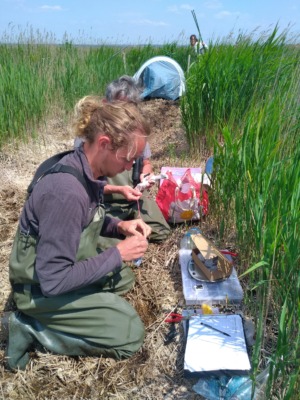 The Tour du Valat has been significantly involved in acquiring telemetry data alongside the CEFE/CNRS and the National Museum of Natural History (MNHN). A wide range of bird sizes were tagged, from 12g Common Redstarts to Greater Flamingos weighing over 4kg, to gain knowledge about how the most representative possible sample of migratory and seabirds cross the Mediterranean Sea. In parallel with the telemetry work, the Tour du Valat monitored the analysis of the results and participated in project communication activities. 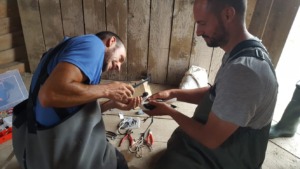 |
Unprecedented knowledge
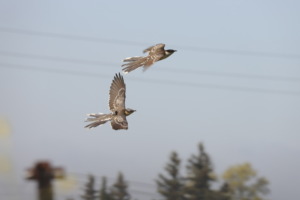
295 bird species were recorded as regularly or occasionally visiting the Gulf of Lion. Over the course of the programme, 10 sea campaigns with radars and observers on board were conducted; 40,000 hours of data were recorded by coastal radars; 824 individuals from 40 different bird species were fitted with GPS or GLS tags (for the smallest species). The results obtained are unique, and models have been developed to best answer the following questions:
How do seabirds use Gulf of Lion marine space?
The use of the Gulf of Lion was mapped for seven species of seabirds during the breeding season and eleven species during the winter (details of the results here).
Overview maps of the vulnerability of the seabirds monitored reveal that the areas of highest wind farm risk are mainly concentrated near the coast during the breeding season. Outside the breeding season, additional risk areas appear further offshore, particularly to the west of the Gulf (see map below).
Although these vulnerability maps provide an initial overview covering a significant proportion of the species most regularly observed in the area, they do not allow for a comprehensive assessment of the sensitivity of all marine bird species found in the Gulf of Lion.
.
 |
Map key for priority wind farm area development (Ministerial Decree of October 18, 2024):
|
Which areas have the most intense flows of migratory birds within the Gulf of Lion?
Combining data from onboard radar during sea campaigns and GPS tracking data from 458 large terrestrial migratory birds, the spatial model used for migratory flows reveals that in the autumn migratory intensity is mainly concentrated near the coast, in the western half of the Gulf of Lion.
In this area, there is a large migratory route that starts in the Camargue and runs along the coast to the Spanish border. To a lesser extent, secondary flows cross the Gulf from the Camargue due south towards the sea, as well as areas used in a strip of sea to the east towards Sardinia and Tunisia.

|
These maps show the relative migratory intensity in the Gulf of Lion of migratory birds during the pre-breeding season (January–June) and post-breeding season (July–December), based on a model that combines:
– GPS locations of large birds (>75g) – Echoes recorded at night by vertical radar during boat transects The thumbnail at the bottom right indicates the levels of uncertainty (coefficient of variation) associated with the model predictions for each grid cell: the higher the value, the more uncertain the prediction. |
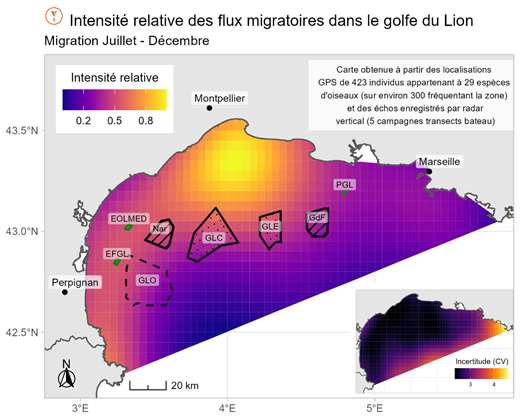
Spring migration has similar characteristics to autumn migration, but with a more coastal flow and maximum migration intensities in the western part of the Gulf of Lion.
These results show a significant overlap, particularly during the pre-breeding migration season, between areas of high migration intensity and those being considered for the construction of offshore wind farms in the Gulf of Lion.
How high do land migrants fly when crossing the Gulf of Lion?
Combined data from coastal radars and GPS beacons reveal little seasonal variation in flight height distribution (median of 150 m in autumn, 157 m in spring). A significant proportion (51% of predicted flight heights) of flights take place at altitudes within the reach of wind turbine blades (below 300 meters). For small birds such as passerines, the data collected is limited, but 10 of the 28 crossings (36%) took place at a median altitude of less than 500 meters above sea level.
What conclusions can be drawn about the development of offshore wind farms?
The Migralion programme has significantly enriched our knowledge of how birds use the Gulf of Lion. In the context of the development of wind farms in the Mediterranean Sea, the results reveal a marked vulnerability of seabirds and migratory species, which frequently fly near wind turbine blades. Spatial data on the flight altitude of large birds confirm the risks of direct (collisions) and indirect (avoidance) interactions with future offshore wind projects.
Although further studies could refine these observations for specific species, the challenge now lies in quantifying actual mortality and assessing its effects on bird population dynamics.
The Ministerial Decree of October 18, 2024, resulting from the public debate about the sea, defined priority areas for floating wind farms in the Mediterranean over the next 10 years and in 2050, without waiting for the Migralion results.
Scientists at the Tour du Valat recommend three principles:
- Prioritize energy efficiency, because any development project has an impact on biodiversity.
- Replace fossil fuels with renewable energies rather than combining them,
- Finally, rigorously apply the AVC (Avoid-Reduce-Compensate) system in the development of wind farms in the Mediterranean Sea, incorporating the Migralion findings. In particular, to limit biodiversity loss, the areas identified as at risk by the programme must be avoided.
Acquire new data to better understand cumulative impacts
Seabirds and long-distance terrestrial migrants, which are species with long life expectancies, are particularly vulnerable to offshore wind turbines: any increase in mortality can have a significant impact on their populations. Whereas small species have faster population dynamics, migrants have been in decline across the board for several decades.
Direct measurement of collisions at sea remains complex, as carcasses generally fall into the water, but studies in the North Sea suggest that this is potentially a significant phenomenon. There is an urgent need to better predict the impacts of collisions with or avoidance of wind turbines on population dynamics. However, modeling demographic impacts on migratory species is currently a methodological challenge, particularly when it comes to assigning mortalities to their populations of origin.
Furthermore, the simultaneous impacts of offshore wind turbines, industrial fishing, maritime traffic, light and plastic pollution, and the effects of climate change create a complex environmental context in which disturbances do not necessarily add up but can interact and amplify their effects. Understanding these cumulative impacts is a major challenge for bird conservation, but also an essential step in ensuring the sustainable development of marine energy, based on a detailed understanding of the ecological dynamics at the marine ecosystem level.
Final word:
Thanks to the MIGRALION project, which has mobilized numerous teams including that of the Tour du Valat, we are beginning to understand the mysteries of bird migration between Europe and Africa. The government and operators of future offshore wind projects must take account of the valuable data produced. – Jean Jalbert
Contact
Jocelyn Champagnon, Research Director, Tour du Valat
Financial partners
- French Biodiversity Agency
- French Ministry of the Environment
- Sud and Occitanie Regions
Technical partners
Main members and organisations in the MIGRALION consortium: CEFE/CNRS, MNHN, Biotope, France Energies Marines, Pôle Mer Méditerranée
Numerous collaborators and partners contributed to the successful completion of this programme. The significant telemetry data collected would not have been possible without the dedication of the bird ringers, their assistants, and the volunteers who accompanied them, the organizations and site managers who hosted these operations, and many other project partners:
SMCG, Friends of the Vigueirat Marshes, Vigueirat Marshes Reserve, COGARD, Grand site Salagou – Cirque de Mourèze, A. Rocha, League for the Protection of Birds, Groupe Salins, Roussillon Ornithological Group, Monticola, Aude Nature, Med Migration, CEN PACA, CEN Occitanie, Coussouls de Crau National Reserve, Camargue Regional Natural Park, French coastal protection agency, Calanques National Park, Port-Cros National Park, Swiss Ornithological Station.