
Tour du Valat
Tour du Valat
  • Navigation access
  • Content access
  • Footer access
  • Adopt a flamingo
  • Documentary portal
  • Search
  • fr
  • en
  • The Tour du Valat
    • History and values
    • The estate
    • Agroecological products
    • Our team
    • Organisation chart and CVs
    • Governance and budget
    • Partners and sponsors
    • Visiting the Tour du Valat
  • Mediterranean wetlands
    • Types of Mediterranean wetlands
    • Biodiversity
    • Threats, issues and protection
    • Spotlight on the Camargue
    • The Mediterranean Alliance for Wetlands
    • The Mediterranean Wetlands Observatory
  • Our actions
  • Media
    • The Library
    • Recent publications
    • Activity reports
    • The HAL portal
    • Books, booklets and reports
    • Institutionnal documents
    • Photo gallery
    • Videos
  • News
  • Our products
    • Adopt a Flamingo
  • Navigation access
  • Content access
  • Footer access
  • Adopt a flamingo
  • Documentary portal
  • Search
  • fr
  • en
Tour du Valat
  • The Tour du Valat
    • History and values
    • The estate
    • Agroecological products
    • Our team
    • Organisation chart and CVs
    • Governance and budget
    • Partners and sponsors
    • Visiting the Tour du Valat
  • Mediterranean wetlands
    • Types of Mediterranean wetlands
    • Biodiversity
    • Threats, issues and protection
    • Spotlight on the Camargue
    • The Mediterranean Alliance for Wetlands
    • The Mediterranean Wetlands Observatory
  • Our actions
  • Media
    • The Library
    • Recent publications
    • Activity reports
    • The HAL portal
    • Books, booklets and reports
    • Institutionnal documents
    • Photo gallery
    • Videos
  • News
  • Our products
    • Adopt a Flamingo
Research institute for the conservation of Mediterranean wetlands
  • Home
  • News
  • Publications
  • Restoring European coastal wetlands: climate benefits vary from one context to another
Back to News
  • A- Switch to smaller font size
  • A+ Switch to biggest font size
  • Print
  • Share
  • RSS
Publications Camargue, Lituanie, Mediterranean, Netherlands, Portugal, Romania, Spain • Published on 17 September 2026

Restoring European coastal wetlands: climate benefits vary from one context to another

A new study published in Ecological Engineering sheds light on the effects of coastal wetland restoration on the climate, particularly on carbon dioxide (CO₂) and methane (CH₄) fluxes — two greenhouse gases whose exchanges with the atmosphere play an important role in regulating the Earth’s climate.

Conducted as part of the European RESTORE4Cs project, in which Tour du Valat is a partner, the study brought together around fifty researchers across six pilot wetlands covering a wide range of European ecological contexts: Ria de Aveiro (Portugal), the Eastern Scheldt Estuary (Netherlands), the Camargue (France), the Marjal dels Moros (Spain), the Danube Delta (Romania) and the Curonian Lagoon (Lithuania).
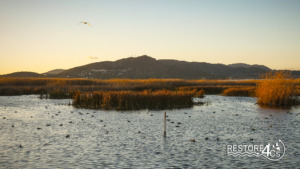
Marjal dels Moros, an emblematic example of a Valencian wetland in Spain © RESTORE4Cs

Over four seasons, the teams simultaneously measured CO₂ and CH₄ fluxes at preserved, degraded and restored sites using static chambers. The goal was to determine the extent to which restoration measures, encouraged by European policies, translate into a measurable climate benefit in terms of CO₂ equivalents (CO₂-eq).

Results vary depending on the type of gas and wetland 

CO₂ fluxes depend primarily on vegetation cover and the flooding regime at the landscape scale, whilst CH₄ emissions respond more sensitively to factors such as water quality, salinity, and hydrological dynamics.

Among the measures studied, the restoration of seagrass meadows through replanting shows the clearest positive climate signal, with a significant reduction in the CO₂-eq. balance, whether the effect of methane is considered over the short term (20 years) or the longer term (100 years). Reducing lagoon eutrophication through improved water treatment also showed a positive effect, but only in the short term (over a 20-year horizon). In contrast, other restoration measures modified CO2 and CH4 fluxes in opposing directions, with no significant effect on the overall balance.

Restoration strategies need to be adapted to each context 

This work provides useful insight for wetland managers: the climate benefits of restoration are neither automatic nor uniform. They depend on the greenhouse gas in question, the type of wetland, and the specific restoration measure undertaken. This makes a case for restoration strategies tailored to each context, and for rigorous monitoring of several greenhouse gases — particularly CO₂ and CH₄ — to accurately detect and quantify potential climate benefits. 
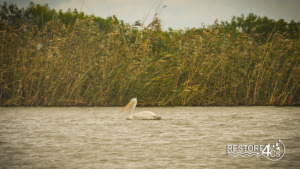
A white pelican (Pelecanus onocrotalus) at the Danube Delta site in Romania © RESTORE4Cs

These results form part of the work carried out by the European RESTORE4Cs project, which develops knowledge, data, and decision-support tools to support the conservation and restoration of European coastal wetlands. They contribute, in particular, to the European Coastal Wetlands Interactive Platform and its Decision-Support Toolbox, which enable users to explore the project’s results and support the prioritisation of restoration actions. 


Publication reference

📄 Cabrera-Brufau M. et al. 2026. Ecological Engineering 232:108080. doi.org/10.1016/j.ecoleng.2026.108080 

For further

Links

  • RESTORE4Cs Project
  • European Coastal Wetlands Interactive Platform
  • Decision-Support Toolbox

Newsletter

Keep up with Tour du Valat news:
Show previous newsletters
News Archives
  • 2026
  • 2025
  • 2024
  • 2023
  • 2022
  • 2021
  • 2020
  • 2019
  • 2018
  • 2017
  • 2016
  • 2015
  • 2014
  • 2013
Agenda Archives
  • 2026
  • 2025
  • 2024
  • 2023
  • 2022
  • 2021
  • 2020
  • 2019
  • 2018
  • 2017
  • 2016
  • 2015
Tour du Valat
Tour du Valat

Le Sambuc - 13200 Arles
France

Phone : +33 (0)4 90 97 20 13

[email protected]


Contact
  • Practical information
    • Calendar
    • News
    • Our products
    • Vacancies
    • Receive our updates
    • Logo & access map
  • Legal information
    • Legal notice
    • Cookie policy (EU)
  • Linkedin
  • Facebook
  • Vimeo
  • RSS
Gérer le consentement aux cookies
We use cookies to enhance your experience on our web site.
Functional Always active
The technical storage or access is strictly necessary for the legitimate purpose of enabling the use of a specific service explicitly requested by the subscriber or user, or for the sole purpose of carrying out the transmission of a communication over an electronic communications network.
Settings
Le stockage ou l’accès technique est nécessaire dans la finalité d’intérêt légitime de stocker des préférences qui ne sont pas demandées par l’abonné ou l’utilisateur.
Statistics
The technical storage or access that is used exclusively for statistical purposes. Le stockage ou l’accès technique qui est utilisé exclusivement dans des finalités statistiques anonymes. En l’absence d’une assignation à comparaître, d’une conformité volontaire de la part de votre fournisseur d’accès à internet ou d’enregistrements supplémentaires provenant d’une tierce partie, les informations stockées ou extraites à cette seule fin ne peuvent généralement pas être utilisées pour vous identifier.
Marketing
The technical storage or access is required to create user profiles to send advertising, or to track the user on a website or across several websites for similar marketing purposes.
  • Manage options
  • Manage services
  • Manage {vendor_count} vendors
  • Read more about these purposes
See settings
  • {title}
  • {title}
  • {title}