
Tour du Valat
Tour du Valat
  • Navigation access
  • Content access
  • Footer access
  • Adopt a flamingo
  • Documentary portal
  • Search
  • fr
  • en
  • The Tour du Valat
    • History and values
    • The estate
    • Our team
    • Organisation chart and CVs
    • Governance and budget
    • Partners and sponsors
    • Visiting the Tour du Valat
  • Mediterranean wetlands
    • Types of Mediterranean wetlands
    • Threats, issues and protection
    • Spotlight on the Camargue
    • The Mediterranean Alliance for Wetlands
    • The Mediterranean Wetlands Observatory
  • Our actions
  • Media
    • The Library
    • Recent publications
    • Activity reports
    • The HAL portal
    • Books, booklets and reports
    • Institutionnal documents
    • Photo gallery
    • Videos
  • News
  • Our products
    • Agroecological products
    • Adopt a Flamingo
  • Navigation access
  • Content access
  • Footer access
  • Adopt a flamingo
  • Documentary portal
  • Search
  • fr
  • en
Tour du Valat
  • The Tour du Valat
    • History and values
    • The estate
    • Our team
    • Organisation chart and CVs
    • Governance and budget
    • Partners and sponsors
    • Visiting the Tour du Valat
  • Mediterranean wetlands
    • Types of Mediterranean wetlands
    • Threats, issues and protection
    • Spotlight on the Camargue
    • The Mediterranean Alliance for Wetlands
    • The Mediterranean Wetlands Observatory
  • Our actions
  • Media
    • The Library
    • Recent publications
    • Activity reports
    • The HAL portal
    • Books, booklets and reports
    • Institutionnal documents
    • Photo gallery
    • Videos
  • News
  • Our products
    • Agroecological products
    • Adopt a Flamingo
Research institute for the conservation of Mediterranean wetlands
  • Home
  • News
  • Media
  • Agricultural practices play a decisive role in the preservation or degradation of natural areas
Back to News
  • A- Switch to smaller font size
  • A+ Switch to biggest font size
  • Print
  • Share
  • RSS
Media Publications Europe • Published on 4 November 2025

Agricultural practices play a decisive role in the preservation or degradation of natural areas

New research shows that modern agriculture is impacting biodiversity inside protected areas in Europe, while some traditional agricultural practices may help preserve it. The Natura 2000 is the largest network of protected areas in the world, established to conserve the most valuables habitats and species in the European Union (EU). Researchers conducted a large-scale survey among Natura 2000 protected area managers across all Europe focusing on management practices, funding and threats to biodiversity facing the Natura 2000 network.

The findings are quite clear: “The main threat to biodiversity conservation inside protected areas in Europe comes from the intensification of agricultural practices, like the use of pesticides, overgrazing and hedgerow removal. It was alarming to learn how managers of protected areas feel that biodiversity is not safe from these harmful practices,” says doctoral researcher Giorgio Zavattoni from the University of Turku, Finland.

Intensive agriculture, a threat to natural sites

Indeed, 80% of habitats of community interest in the European Union are in an unfavorable state of conservation, with national reports suggesting that the main driver for habitat degradation is intensive agriculture, a process characterized by increased use of inorganic fertilizers, pesticides, and new crop types including winter crops. The findings of this study reveal that these agricultural pressures pose in fact significant challenges for protected area managers, who often cannot address them fully. This highlights how the simple designation of a protected area does not itself ensure the effective conservation of its habitats and species, because stakeholder involvement and active management is often essential.
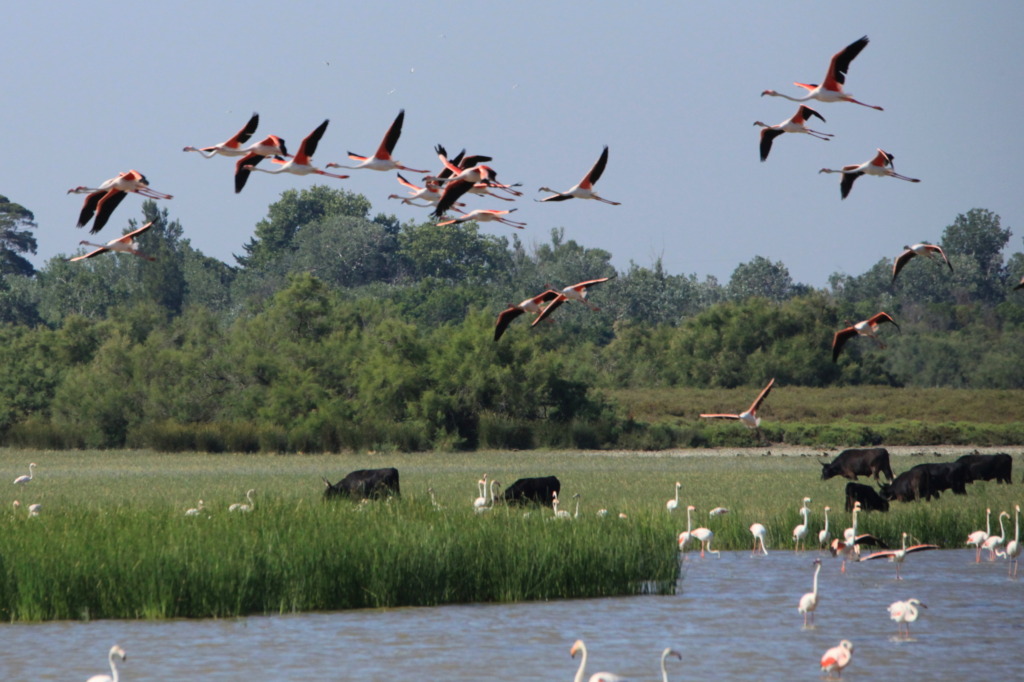
Paysage de Camargue avec au premier plan un basssin d'eau dans lequel patogent des flamants rose, au deuxième plan, des toreaux qui paissent dans les herbes, et au troisième plan une envolée de flamants roses
Camargue grazing © Jean Jalbert – Tour du Valat

Traditional agriculture practices, a key tool

Are protected area managers against agriculture inside protected areas? The answer is no. In fact, some of the most common measures implemented by Natura 2000 managers to improve the state of biodiversity coincide with some traditional low-intensity farming methods. Practices such as sustainable grazing and mowing play a key role in preserving important habitats vital for many endangered species.

“Grasslands and marshes are among the most biodiversity-rich ecosystems in Europe, and protected area managers may use extensive grazing to ensure the conservation of these habitats” explains Elie Gaget, researcher at the Tour du Valat, research institute for the conservation of Mediterranean wetlands (France), and co-author of the study. Unfortunately, with the intensification of agriculture, these traditional practices are disappearing in the European Union.

Funding available to manage Natura 2000 protected areas often relies on the European Union’s Common Agricultural Policy (CAP), which Member States apply through their own national programme. The same instrument also provides subsidies, among other things, to intensive agricultural practices even inside protected areas

Professor Jon Brommer, co-author of the study based at the University of Turku (Finland), explains: “The Natura 2000 network aims at protecting biodiversity without excluding human activities. However, it is confusing to use public money to support two very different approaches, with mixed effects on biodiversity.”

Overall, the study underscores the urgent need to strengthen agricultural regulations inside protected areas if the European Union is to achieve its biodiversity conservation goals. Many of the biodiversity-friendly measures that were included in the initial proposals of the European Green Deal were removed after spring 2024.

The study highlights how low-intensity agricultural practices, both within and around natural sites, are necessary for the conservation of European biodiversity.


Publication reference

Giorgio Zavattoni, Elie Gaget, Ineta Kačergytė, Tomas Pärt, Thomas Sattler, Tyler Hallman, Diego Pavón-Jordán & Jon E. Brommer. Threats and management of Natura 2000 protected areas in relation to current agricultural practices. Conservation Biology. 2025. DOI: 10.1111/cobi.70172

For further

Downloads

Press release

Agenda

March 19, 2026 at 10:00h

Webinaire – The Mediterranean Wetland Outlook 3 and the Mediterranean Wetlands Geoportal
Seminars • Mediterranean
All events

Newsletter

Keep up with Tour du Valat news:
Show previous newsletters
News Archives
  • 2026
  • 2025
  • 2024
  • 2023
  • 2022
  • 2021
  • 2020
  • 2019
  • 2018
  • 2017
  • 2016
  • 2015
  • 2014
  • 2013
Agenda Archives
  • 2024
  • 2023
  • 2022
  • 2021
  • 2020
  • 2019
  • 2018
  • 2017
  • 2016
  • 2015
  • 2014
  • 2013
Tour du Valat
Tour du Valat

Le Sambuc - 13200 Arles
France

Phone : +33 (0)4 90 97 20 13

[email protected]


Contact
  • Practical information
    • Calendar
    • Past events
    • Vacancies
    • Interactive map
    • Logo & access map
  • Legal information
    • Legal notice
    • Cookie policy (EU)
  • Linkedin
  • Facebook
  • Vimeo
  • RSS
Gérer le consentement aux cookies
We use cookies to enhance your experience on our web site.
Functional Always active
The technical storage or access is strictly necessary for the legitimate purpose of enabling the use of a specific service explicitly requested by the subscriber or user, or for the sole purpose of carrying out the transmission of a communication over an electronic communications network.
Settings
Le stockage ou l’accès technique est nécessaire dans la finalité d’intérêt légitime de stocker des préférences qui ne sont pas demandées par l’abonné ou l’utilisateur.
Statistics
The technical storage or access that is used exclusively for statistical purposes. Le stockage ou l’accès technique qui est utilisé exclusivement dans des finalités statistiques anonymes. En l’absence d’une assignation à comparaître, d’une conformité volontaire de la part de votre fournisseur d’accès à internet ou d’enregistrements supplémentaires provenant d’une tierce partie, les informations stockées ou extraites à cette seule fin ne peuvent généralement pas être utilisées pour vous identifier.
Marketing
The technical storage or access is required to create user profiles to send advertising, or to track the user on a website or across several websites for similar marketing purposes.
Manage options Manage services Manage {vendor_count} vendors Read more about these purposes
See settings
{title} {title} {title}