
Tour du Valat
Tour du Valat
  • Navigation access
  • Content access
  • Footer access
  • Adopt a flamingo
  • Documentary portal
  • Search
  • fr
  • en
  • The Tour du Valat
    • History and values
    • The estate
    • Agroecological products
    • Our team
    • Organisation chart and CVs
    • Governance and budget
    • Partners and sponsors
    • Visiting the Tour du Valat
  • Mediterranean wetlands
    • Types of Mediterranean wetlands
    • Biodiversity
    • Threats, issues and protection
    • Spotlight on the Camargue
    • The Mediterranean Alliance for Wetlands
    • The Mediterranean Wetlands Observatory
  • Our actions
  • Media
    • The Library
    • Recent publications
    • Activity reports
    • The HAL portal
    • Books, booklets and reports
    • Institutionnal documents
    • Photo gallery
    • Videos
  • News
  • Our products
    • Adopt a Flamingo
  • Navigation access
  • Content access
  • Footer access
  • Adopt a flamingo
  • Documentary portal
  • Search
  • fr
  • en
Tour du Valat
  • The Tour du Valat
    • History and values
    • The estate
    • Agroecological products
    • Our team
    • Organisation chart and CVs
    • Governance and budget
    • Partners and sponsors
    • Visiting the Tour du Valat
  • Mediterranean wetlands
    • Types of Mediterranean wetlands
    • Biodiversity
    • Threats, issues and protection
    • Spotlight on the Camargue
    • The Mediterranean Alliance for Wetlands
    • The Mediterranean Wetlands Observatory
  • Our actions
  • Media
    • The Library
    • Recent publications
    • Activity reports
    • The HAL portal
    • Books, booklets and reports
    • Institutionnal documents
    • Photo gallery
    • Videos
  • News
  • Our products
    • Adopt a Flamingo
Research institute for the conservation of Mediterranean wetlands
  • Home
  • News
  • News
  • More insight into nocturnal migration among small land birds
Back to News
  • A- Switch to smaller font size
  • A+ Switch to biggest font size
  • Print
  • Share
  • RSS
News France • Published on 9 September 2026

More insight into nocturnal migration among small land birds

Most land-dwelling birds are diurnal species. However, the majority of them migrate at night. In order to quantify this phenomenon more accurately and gain a better understanding of its evolution, an international study, published in the journal *Current Biology*, combined and analysed data from more than 400 small birds fitted with tiny tracking devices.

Why do diurnal species suddenly change their behaviour when it comes to migrating? Although widely documented, this fascinating phenomenon still raises many questions today. Flying at night may allow birds to benefit from more stable atmospheric conditions, avoid the heat and diurnal predators, or even guide themselves by the stars. However, measuring the true extent of this behaviour across dozens of species has, until now, remained difficult, as radar, acoustic recordings and bird ringing provide information on the passage of birds, but rarely on the complete journey of a single individual or the exact duration of its flights.

Tiny geolocation trackers to monitor flights

An international team of more than seventy researchers has compiled published and unpublished data from multi-sensor trackers fitted to 411 individual birds belonging to 56 species of passerines and other terrestrial birds. A database of this kind, combining so many species and individuals fitted with trackers over the long term, is a first in the field, particularly for small birds.

Attached to the bird’s back, these sensors record light, acceleration and atmospheric pressure at regular intervals, enabling data to be collected throughout the bird’s entire migratory journey. Their weight never exceeds 5 per cent of the bird’s body weight, so as not to affect its activity.

Nocturnal migration: a highly prevalent strategy
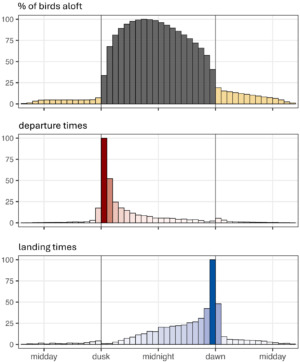
Breakdown of migratory flight times between day and night, for all flights combined (12,542 flights) undertaken by 411 individuals, totalling 84,477 hours of flight time
  • Analysis of this extensive dataset confirms and refines what several smaller-scale studies had already suggested:
  • The vast majority of migratory flights take place at night: across all the species studied, 82 per cent of all recorded flights occurred during the night. When crossing ecological barriers such as deserts or the sea, some flights may continue during the day.
  • Nocturnal migration is the dominant strategy for many species: in 41 of the 56 species studied, more than 90 per cent of migratory journeys took place at night.
  • Some species believed to migrate both by day and by night actually migrate almost exclusively at night: for example, the Eurasian Hoopoe (Upupa epops) undertakes 91 per cent of its migratory flights at night, which contradicts previous observations and highlights that diurnal activity does not necessarily reflect the timing of the migratory flight.
  • Nocturnal migratory birds tend to optimise their flight time during the night: departures and arrivals are closely aligned with dusk and dawn, with 92 per cent of species taking off at dusk and 96 per cent landing at dawn.

A behaviour passed down through evolution

Beyond these findings, the researchers sought to understand the origin of this behaviour. By placing the 56 species within their phylogenetic tree, they demonstrate that closely related species bear a strong resemblance to one another: nocturnal migration is passed down and maintained within lineages, rather than depending on the specific ecological conditions of each species. The authors remain cautious, however: this trait could also have arisen independently on several occasions, under similar pressures.

This pattern is not, however, universal. The European bee-eater is the clearest counter-example: it flies almost exclusively by day, its gliding flight dependent on thermal updrafts. Certain groups, such as pipits and wagtails, undertake a higher proportion of daytime flights than others, often over short distances, early in the morning.

Eurasian hoopoe © Lukas Kott - Wikimedia Commons

Prospects for the conservation of migratory birds

Gaining a better understanding of birds’ migratory strategies is not merely an academic matter: populations of nocturnal migratory birds are particularly vulnerable to light pollution and collisions with human infrastructure (buildings, wind turbines, power lines), which are becoming increasingly common along their flight paths. Developing detailed maps of the extent and timing of nocturnal migration, species by species, is an essential step towards identifying the periods and areas where these risks are highest, and tailoring conservation measures accordingly.


Publication reference

Dufour P., Nussbaumer R., Doniol-Valcroze P., Rime Y., Adamík P., Åkesson S. et al., Briedis M. 2026. Multi-sensor tracking reveals the extent of nocturnal migration in landbirds. Current Biology 36(14):3697-3706.e3. DOI: 10.1016/j.cub.2026.06.030

Newsletter

Keep up with Tour du Valat news:
Show previous newsletters
News Archives
  • 2026
  • 2025
  • 2024
  • 2023
  • 2022
  • 2021
  • 2020
  • 2019
  • 2018
  • 2017
  • 2016
  • 2015
  • 2014
  • 2013
Agenda Archives
  • 2026
  • 2025
  • 2024
  • 2023
  • 2022
  • 2021
  • 2020
  • 2019
  • 2018
  • 2017
  • 2016
  • 2015

Related
projects

All projects
Ongoing project
Species Conservation

Participatory project: a study on the migratory behaviour of Eurasian Spoonbills

Camargue, France, Mediterranean
Tour du Valat
Tour du Valat

Le Sambuc - 13200 Arles
France

Phone : +33 (0)4 90 97 20 13

[email protected]


Contact
  • Practical information
    • Calendar
    • News
    • Our products
    • Vacancies
    • Receive our updates
    • Logo & access map
  • Legal information
    • Legal notice
    • Cookie policy (EU)
  • Linkedin
  • Facebook
  • Vimeo
  • RSS
Gérer le consentement aux cookies
We use cookies to enhance your experience on our web site.
Functional Always active
The technical storage or access is strictly necessary for the legitimate purpose of enabling the use of a specific service explicitly requested by the subscriber or user, or for the sole purpose of carrying out the transmission of a communication over an electronic communications network.
Settings
Le stockage ou l’accès technique est nécessaire dans la finalité d’intérêt légitime de stocker des préférences qui ne sont pas demandées par l’abonné ou l’utilisateur.
Statistics
The technical storage or access that is used exclusively for statistical purposes. Le stockage ou l’accès technique qui est utilisé exclusivement dans des finalités statistiques anonymes. En l’absence d’une assignation à comparaître, d’une conformité volontaire de la part de votre fournisseur d’accès à internet ou d’enregistrements supplémentaires provenant d’une tierce partie, les informations stockées ou extraites à cette seule fin ne peuvent généralement pas être utilisées pour vous identifier.
Marketing
The technical storage or access is required to create user profiles to send advertising, or to track the user on a website or across several websites for similar marketing purposes.
  • Manage options
  • Manage services
  • Manage {vendor_count} vendors
  • Read more about these purposes
See settings
  • {title}
  • {title}
  • {title}