
The Rhône is one of the main sources of sediment and organic carbon for the Mediterranean Sea. Every year, it carries nearly 5.5 million tons of sediment – the equivalent of 2,000 Olympic swimming pools – and 173,000 tons of organic carbon, a volume comparable to what 870,000 trees can absorb in a year, to the sea. These inputs nourish marine ecosystems, support biodiversity, help to curb natural coastal erosion and slow down the retreat of the coastline, particularly in the Camargue and the Gulf of Lion. Without them, beaches and coastal infrastructure would be even more exposed to storms and rising sea levels. But this balance is fragile: in a century, dams have reduced these flows by 60%, while climate change is altering flood patterns, concentrating 70% of inflows in just 10% of the year.
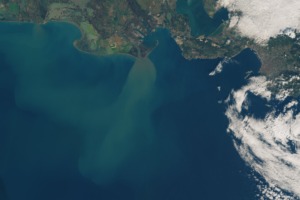
A recent study published in March 2026, conducted by a research team including the Tour du Valat, used the SWAT-C (Soil and Water Assessment Tool – Carbon) model for the first time to quantify organic carbon dynamics in the vast Rhône River basin between 2002 and 2020. Results reveal that Alpine tributaries, such as the Durance and Isère rivers, contribute 70% of the organic carbon transported, mainly in labile form – a biodegradable fraction that is easily assimilated by microorganisms, actively participates in the carbon cycle and reflects the good health of ecosystems.
However, these figures are accompanied by significant margins of uncertainty. Although pioneering, the model still underestimates certain local variations, such as the precise impact of dams on fine sediments, and requires more detailed data to better predict, in particular, carbon degradation at sea and the cumulative effect of small tributaries. Furthermore, future scenarios – related to climate or dam management – remain difficult to model accurately.
So what can be done? Scientists insist on one point: before considering adaptation solutions, such as modifying dam releases, it is essential to improve the model by incorporating more field measurements and reducing its margins of error. One thing is certain: the Rhône is a veritable open-air laboratory for understanding how to reconcile water security, coastal preservation and the fight against global warming – a challenge that extends far beyond our borders and concerns all Mediterranean coastlines.
Publication reference
Fabre C., Copard Y., Sauvage S., Radakovitch O., Piegay H., Sánchez-Pérez J.M., Fressard M., Boutron O. 2026. Integrated modelling of sediment and organic carbon fluxes in a large catchment: quantifying riverine contributions to the Mediterranean Sea. CATENA 264:109794. DOI: 10.1016/j.catena.2026.109794
Contact
Olivier Boutron | Research Director – Wetland Dynamics and Water Management Theme