
Tour du Valat
Tour du Valat
  • Navigation access
  • Content access
  • Footer access
  • Adopt a flamingo
  • Documentary portal
  • Search
  • fr
  • en
  • The Tour du Valat
    • History and values
    • The estate
    • Our team
    • Organisation chart and CVs
    • Governance and budget
    • Partners and sponsors
    • Visiting the Tour du Valat
  • Mediterranean wetlands
    • Types of Mediterranean wetlands
    • Threats, issues and protection
    • Spotlight on the Camargue
    • The Mediterranean Alliance for Wetlands
    • The Mediterranean Wetlands Observatory
  • Our actions
  • Media
    • The Library
    • Recent publications
    • Activity reports
    • The HAL portal
    • Books, booklets and reports
    • Institutionnal documents
    • Photo gallery
    • Videos
  • News
  • Our products
    • Agroecological products
    • Adopt a Flamingo
  • Navigation access
  • Content access
  • Footer access
  • Adopt a flamingo
  • Documentary portal
  • Search
  • fr
  • en
Tour du Valat
  • The Tour du Valat
    • History and values
    • The estate
    • Our team
    • Organisation chart and CVs
    • Governance and budget
    • Partners and sponsors
    • Visiting the Tour du Valat
  • Mediterranean wetlands
    • Types of Mediterranean wetlands
    • Threats, issues and protection
    • Spotlight on the Camargue
    • The Mediterranean Alliance for Wetlands
    • The Mediterranean Wetlands Observatory
  • Our actions
  • Media
    • The Library
    • Recent publications
    • Activity reports
    • The HAL portal
    • Books, booklets and reports
    • Institutionnal documents
    • Photo gallery
    • Videos
  • News
  • Our products
    • Agroecological products
    • Adopt a Flamingo
Research institute for the conservation of Mediterranean wetlands
  • Home
  • News
  • News
  • When ponds come back to life
Back to News
  • A- Switch to smaller font size
  • A+ Switch to biggest font size
  • Print
  • Share
  • RSS
News Camargue, Mediterranean • Published on 10 March 2026

When ponds come back to life

At the heart of our estate, a pine forest planted after the Second World War is home to small ponds nestled on a dune ridge that is thousands of years old. At first glance, they seem peaceful. Yet they tell a fragile story.
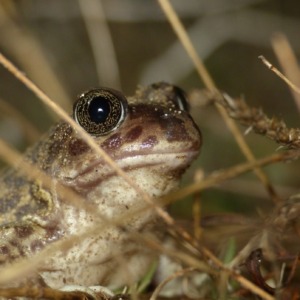
Common spadefoot toad © Julien BIRARD | Tour du Valat

These ponds host a freshwater ecosystem vital to many species. Among them is the spadefoot toad (Pelobates cultripes): a small amphibian that is as discreet as it is endangered, choosing these ponds for reproduction each mating season. But over the past decade, something has been changing. The oak trees in the pine forest are dying. Some reed beds are losing their vitality. And the water… is gradually becoming saturated with salt.

Why ?

Less rain, more evaporation due to global warming… but perhaps also invisible exchanges with surrounding aquifers, whose salinity varies according to the seasons and the management of irrigation and drainage channels.

To understand these mechanisms, scientists at the Tour du Valat are closely monitoring changes in the ponds: salinity measurements every two weeks, installation of piezometers throughout the site, analysis of underground water movements…

The aim? To identify the causes and, if possible, take action to curb this phenomenon.
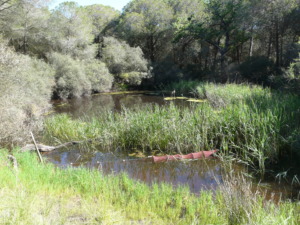
Pond of Petit Saint-Jean © Anthony Olivier | Tour du Valat

This winter, heavy rains have allowed the ponds to fill with fresh water, providing pelobates with optimal conditions for reproduction. Hope is therefore reborn for this protected species.

At the Tour du Valat, cultivating vines also means watching over these invisible balances. Here, each plot tells a story of agriculture and biodiversity coexisting together.

Identity card of the common spadefoot toadSize: 7 to 10 cm long

Identification criteria: Its hind legs are equipped with ‘knives’, allowing it to burrow vertically into the sand. Its back is yellowish-grey dotted with chocolate brown spots.

Behaviour: The Pelobates is only active on certain nights. During the day, it creates small underground burrows (except during the breeding season).

Status: protected species

Chant :

https://tourduvalat.org/wp-content/uploads/2026/03/PABLOD_1.mp3

© Naturalist sound recordist and artist Pablo Diserens


For further

Links

  • The agroecological farm project
  • Discover the PRODUCTS from the agroecological farm
Agenda

March 19, 2026 at 10:00h

Webinaire – The Mediterranean Wetland Outlook 3 and the Mediterranean Wetlands Geoportal
Seminars • Mediterranean

April 25 - April 26, 2026

Weekend at the Tour du Valat agroecological farm – From Farm to Farm Festival 2026
Events • Camargue, France

May 13 - May 17, 2026

The Tour du Valat at the Camargue Festival 2026
Events • Camargue, France
All events

Newsletter

Keep up with Tour du Valat news:
Show previous newsletters
News Archives
  • 2026
  • 2025
  • 2024
  • 2023
  • 2022
  • 2021
  • 2020
  • 2019
  • 2018
  • 2017
  • 2016
  • 2015
  • 2014
  • 2013
Agenda Archives
  • 2024
  • 2023
  • 2022
  • 2021
  • 2020
  • 2019
  • 2018
  • 2017
  • 2016
  • 2015
  • 2014
  • 2013
Tour du Valat
Tour du Valat

Le Sambuc - 13200 Arles
France

Phone : +33 (0)4 90 97 20 13

[email protected]


Contact
  • Practical information
    • Calendar
    • Past events
    • Vacancies
    • Interactive map
    • Logo & access map
  • Legal information
    • Legal notice
    • Cookie policy (EU)
  • Linkedin
  • Facebook
  • Vimeo
  • RSS
Gérer le consentement aux cookies
We use cookies to enhance your experience on our web site.
Functional Always active
The technical storage or access is strictly necessary for the legitimate purpose of enabling the use of a specific service explicitly requested by the subscriber or user, or for the sole purpose of carrying out the transmission of a communication over an electronic communications network.
Settings
Le stockage ou l’accès technique est nécessaire dans la finalité d’intérêt légitime de stocker des préférences qui ne sont pas demandées par l’abonné ou l’utilisateur.
Statistics
The technical storage or access that is used exclusively for statistical purposes. Le stockage ou l’accès technique qui est utilisé exclusivement dans des finalités statistiques anonymes. En l’absence d’une assignation à comparaître, d’une conformité volontaire de la part de votre fournisseur d’accès à internet ou d’enregistrements supplémentaires provenant d’une tierce partie, les informations stockées ou extraites à cette seule fin ne peuvent généralement pas être utilisées pour vous identifier.
Marketing
The technical storage or access is required to create user profiles to send advertising, or to track the user on a website or across several websites for similar marketing purposes.
Manage options Manage services Manage {vendor_count} vendors Read more about these purposes
See settings
{title} {title} {title}