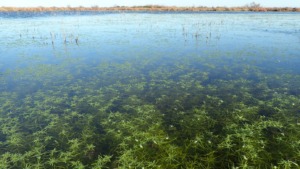
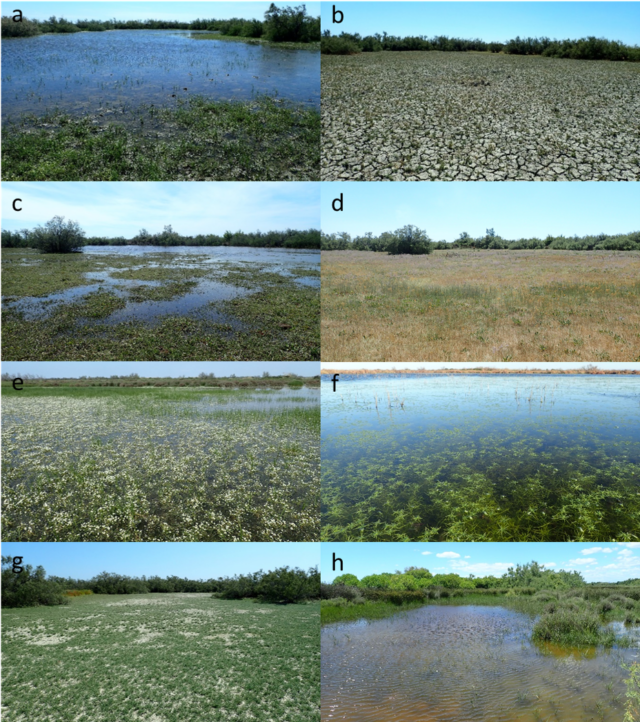
Although often discreet in the landscape, Mediterranean temporary ponds are home to remarkable biodiversity. Fed by autumn and winter rains, they gradually dry up in spring before remaining dry throughout the summer. This natural alternation between wet and dry phases favours a highly specialised flora, capable of withstanding hydrological conditions that vary greatly year to year.
Long overlooked, sometimes drained in or altered, these ponds are among the most threatened habitats in Europe. Their conservation depends both on protecting existing ponds and on restoring, or even creating, new habitats.
In the Camargue, many natural ponds have disappeared or been severely degraded over the last two centuries, whilst others have been created by chance or to compensate for the widespread destruction of wetlands. But do these artificial ponds, over time, manage to regain the characteristics of natural ponds? This is the question a team from the Tour du Valat has sought to answer by comparing the vegetation of ponds created at different times with a set of natural reference ponds.
A long-term study
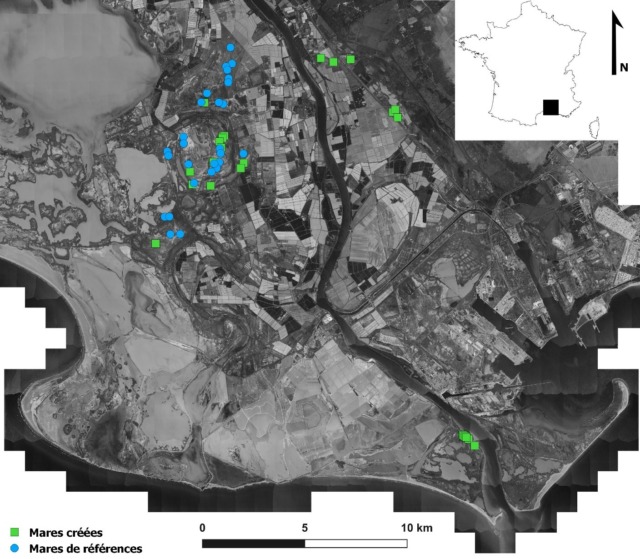
To monitor the long-term changes in the ponds, the researchers compared the terrestrial and aquatic vegetation of 24 artificial ponds, created at different times (over 150 years ago, between 50 and 100 years ago, and less than 15 years ago), with that of 27 natural reference ponds spread across the Camargue.
For each pond, a series of surveys was carried out at various points in the annual cycle, from spring to late summer – in 2019 and 2020 for the reference ponds, and in 2020 for the artificial ponds – in order to account for the significant seasonal variations characteristic of these environments. The scientists recorded the composition of plant communities, their abundance by season, as well as parameters such as water depth, salinity and the physico-chemical conditions of the soil.
The aim was to understand what is restored… and what is not when temporary ponds are created. This original approach has enabled the observation of restoration trajectories over an exceptional period of more than 150 years.
Results
First observation: the created ponds are home to a rich and diverse flora. The total number of species is generally comparable to that observed in natural ponds.
However, a detailed analysis of restoration trajectories reveals significant contrasts depending on the age of the ponds. Recently created ponds (less than 15 years old) are not yet fully restored, although some are already showing favourable trends and are becoming more similar to the reference ponds. In contrast, the oldest ponds (created in the 19th century or in the 1970s) appear, for the most part, to be much closer to natural communities.
These results confirm that wetland restoration is a slow process. Furthermore, certain plant communities characteristic of natural ponds remain absent, or are very rarely observed in the created ponds, particularly the rarest and most threatened species. Further analysis could help determine whether this absence is due to environmental conditions that are still unsuitable or to limitations on the dispersal of the species concerned.
Restoration is no substitute for conservation
The creation of ponds is a valuable tool for recreating habitats favourable to many plant species and strengthening the network of wetlands in the Camargue. However, certain ecological characteristics take several decades, or even several centuries, to re-establish themselves. Natural ponds therefore remain irreplaceable reservoirs of biodiversity and essential sources of recolonisation for restored habitats.
The study also highlights the importance of long-term monitoring: assessments carried out just a few years after restoration do not always allow us to gauge the true ecological trajectories of ecosystems, particularly in the context of climate change. More than ever, restoration and conservation appear to be two complementary approaches to secure the future of Mediterranean wetlands.
Publication reference:
Fontès H., Grillas P., Dutoit T., Gazaix A., Gaget E., Mesléard F. 2026. Vegetation trajectories over 150 years of temporary ponds created in the Camargue delta (Southern France). Restoration Ecology n/a:e70372. doi: 10.1111/rec.70372 [1]
Contact:
Hugo Fontès [2] | [email protected] [3]