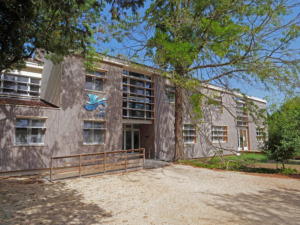
 The Tour du Valat is a research institute for the conservation of Mediterranean wetlands based in the Camargue, under the status of a private foundation recognized as a public utility. Founded in 1954 by Dr. Luc Hoffmann, Tour du Valat has developed research activities with one overall goal: to better understand these environments – wetlands are among the most productive and most threatened ecosystems on the planet – in order to manage them more effectively.
Convinced that Mediterranean wetlands can only be preserved if human activities and the protection of natural heritage go hand in hand, the Tour du Valat has for many years been developing research and integrated management programmes that encourage exchanges between stakeholders and scientists and promote the benefits of wetlands to decision-makers.
The Tour du Valat employs about 100 people, including about 15 researchers and as many project managers, as well as doctoral students, post-doctoral fellows, interns and/or volunteers.
More details on: https://tourduvalat.org/en/ [1]
Tour du Valat offers a 12 months (with possibility of a 6-month extension) postdoctoral position on vulnerability and adaptation to climate change inside the Mediterranean Ramsar network
Background and objectives
Climate change is a major pressure on ecosystems, driving changes in species abundance and distribution. While protected areas have primarily been established with a stationary vision to protect or enhance biodiversity based on historical references, observed and predicted effects of climate change stress the need for adaptative approaches. Climate adaptation strategies are needed to anticipate species vulnerability and management opportunities.
In the Mediterranean region, more than 400 wetlands of international importance are recognized under the Ramsar convention on wetlands (1971). These areas have been designated from diverse criteria, including importance for threatened species, plants, fish, waterbirds or other wetland dependant species. However, the Mediterranean region is also particularly exposed to the effects of climate change, including changes in temperature, precipitation, extreme events and sea level rise (Mediterranean Wetlands Outlook 3, 2025).
This project aims at quantifying wetland species vulnerability to different facets of climate change, inside the Mediterranean Ramsar network of protected areas, and to explore adaptation scenarios based on the “Resist-Accept-Direct” approach (Magness et al. 2022). This project will establish a list of species and Ramsar sites considered to be priorities for future management and conservation support projects. In addition to scientific outcomes, the project will deliver practical information to guide protected area managers in the integration of climate change adaptation strategies into management plans, such as the suggestion of new target species.
The project will be conducted at the Tour du Valat (Arles, France) under the supervision of Elie Gaget, in close collaboration with Thomas Galewski (TDV), Fabien Verniest (MNHN) and Jon Brommer 5university of Turku, Finland). The position is mainly desk-based.
Main tasks
- Quantifying the exposure of each Ramsar site of the Mediterranean region (28 countries) to different facets of climate change (e.g., temperature changes, precipitation changes, extreme events, sea level rise). Climate data will be collected from open access databases (e.g. Chelsa, Copernicus) or directly from the resources available at the Tour du Valat (e.g. sea level rise).
- Estimating species sensitivity to the pre-selected climate change variables. Sensitivity will be assessed from ecological characteristics of the species, such as the climate niche or habitat requirements. The list of species targeted by each Ramsar site is available from the online database (https://rsis.ramsar.org), while information on species distribution range and ecological characteristics are available from open access databases (e.g., IUCN, AVONET, TRY).
- Building conservation scenarios at local to Mediterranean scale, depending on the radiative forcing of climate change and conservation strategies. The application of the Resist-Accept-Direct approach can generate conservation trade-offs at local or regional scales, which can affect conservations outcomes. Spatial optimization of climate adaptation strategies will be assessed by using conservation planning software (e.g. Marxan).
- Leading the writing of scientific manuscripts.
- Building an open access database (e.g. a shiny app) with the main practical outcomes of the project, to guide protected area managers for the implementation of climate adaptation strategies at their sites.
Qualification
- PhD in a field of relevance to the above tasks including (but not limited to) Biology (Ecology), Agriculture and Forestry, Environmental Science or Conservation Science;
- Proficiency in R;
- Proven skills (e.g. publications) in statistical modelling (e.g. use of R packages like glmmTMB, mgcv, sdmTMB, ade4, biomod2) and GIS (‘sf’ and ‘terra’);
- Ability to work both in a team and independently;
- Language skills: Fluency in English (mandatory). Speaking French is not mandatory but the candidate should be comfortable with working in a French-speaking environment;
- Critical thinking and scientific rigor;
- Strong motivation to contribute to scientific and applied biological conservation.
Additional skills that would be considered assets:
- Naturalist skills, particularly on wetland biodiversity;
- Previous knowledge in building a shiny app;
- Experience in spatial conservation planning.
Informations
Postdoctoral position (full time) of 12 months.
The initial contract period could be extended by 6 months, depending on internal funding availability.
Salary: Group G based on the collective convention ECLAT, i.e. from 2600 € to 2800 € (monthly gross salary) depending on professional experience + precarity bonus of 10% at the end of the contract.
Work place: Tour du Valat, Le Sambuc, 13200 Arles, France.
Starting date: 1st July 2026.
Fixed-Term annualized days contract: 206 working days per year (32 days of paid leave per year + between 12 and 14 days off per year – RTT)
Advantages:
- Health insurance with good coverage, 50% of which is paid for by the employer,
- Up to 2 days of remote working per week,
- Canteen,
- Working environment surrounded by natural areas.
ApplicationTo apply please submit i) a cover letter summarizing research interests and expertise; ii) a CV including a list of publications; names and contact information of two referees, all in a single pdf document sent to : [email protected] [2] and copy [email protected] [3] Please add the reference in your application: «TdV 2026 – postdoc-CCMed – Your Name» Application deadline is 4th May 2026. The pre-selected candidates will be invited for an interview by videoconference mid-May. For further questions, please contact: [email protected] [3]
|