The Tour du Valat is helping to foster a new generation of wetland conservationinsts in the Mediterranean through its Mediterranean Ph.D. fellowship. This program funds, supervises, and supports Ph.D. students from non-European countries in the Mediterranean basin to strengthen local research capacity in collaboration with universities and conservation stakeholders.
As part of this initiative, on June 9, 2026, Haytem Bouchri defended his doctoral dissertation at PSL University – École Pratique des Hautes Études – following three years of research on the ecology of a threatened migratory duck, the Marbled duck.
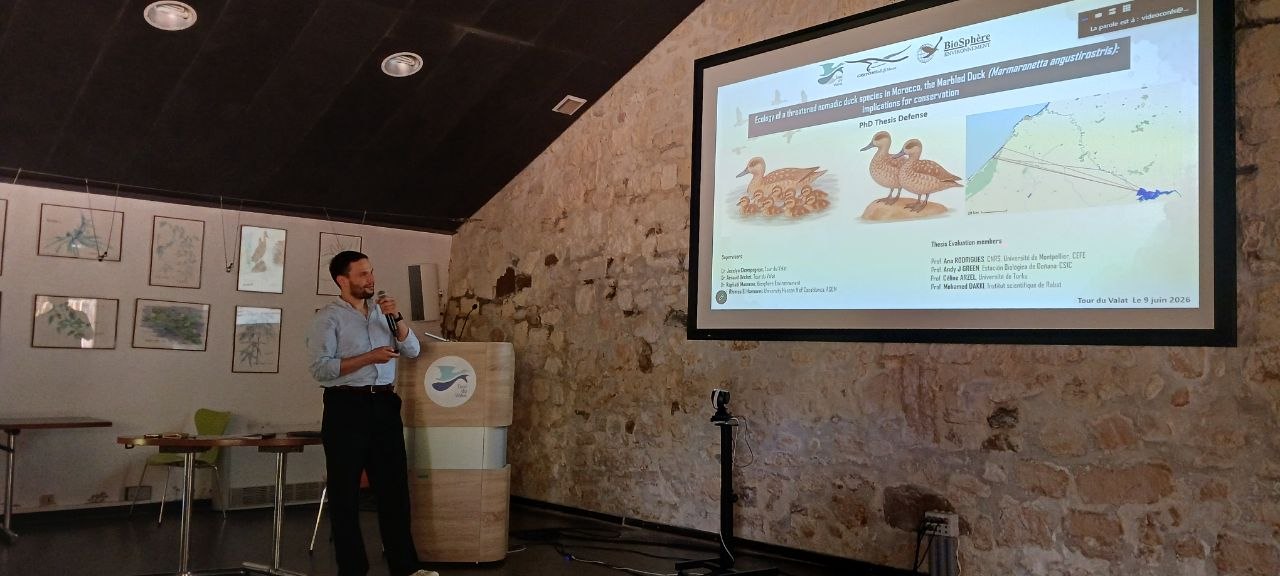
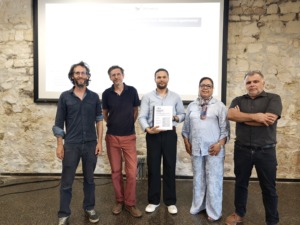
Haytem Bouchri studied this species in partnership with GREPOM (BirdLife Morocco) and Biosphère Environnement, under the supervision of Arnaud Béchet (Tour du Valat) and Rhimou El Hamoumi (Hassan II University of Casablanca), Jocelyn Champagnon (Tour du Valat) and Raphaël Musseau (Biosphère Environnement). The jury, composed of international experts in monitoring, in ducks and/or in wetlands, congratulated Haytem Bouchri on the excellence of his research, noting both the scientific quality of the work and its importance for the conservation of this species. Three articles are in preparation, including one on the population size of the Marbled duck in Morocco that is accepted for publication by the journal Animal Conservation.
ABSTRACT:
‘Ecology of a threatened nomadic duck species in Morocco, the Marbled Duck (Marmaronetta angustirostris): implications for conservation’
Mediterranean wetlands are among the most threatened ecosystems globally, facing increasing pressures from water abstraction, land-use change, and climate-driven water scarcity — pressures especially acute in North Africa. Among the species most affected is the Marbled duck (Marmaronetta angustirostris), a Near Threatened species characterised by nomadic movements, whose western Mediterranean population declined by 46% between 2008 and 2018. Several aspects of its ecology nonetheless remain poorly understood, particularly the size of its breeding population, its movement strategies, and its patterns of habitat use.
This thesis addresses these gaps through three complementary chapters. In the first, a two-stage random sampling design analysed with hierarchical N-mixture models estimated the Moroccan national breeding population at 386 broods [95% CrI: 283–487], providing the first robust national-scale estimate for the species. In the second, combining GPS telemetry with tri-axial accelerometry enabled the classification of five behavioural categories and revealed a marked organisation between daytime roosting and nocturnal foraging, alongside strong inter-individual variation in functional space use. In the third, tracking data from 24 individuals captured in Morocco and Spain showed that wetland type is the main driver of habitat use, with the species relying predominantly on anthropogenic wetlands, and with habitat use modulated by rainfall variability.
Overall, this thesis provides new insights into the spatial ecology of the Marbled duck in North Africa and offers a scientific basis for improving monitoring, habitat restoration, and conservation strategies for the species.