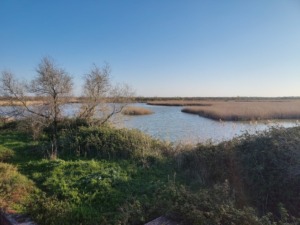
The emergency agricultural bill currently under discussion could lead to an unprecedented weakening of wetland protection. Although this measure has received little media attention, it could nevertheless have a lasting negative impact on the quality of life of the French people.
Press release – 3 July 2026
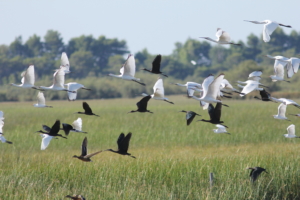
In an era of climate change, heatwaves and catastrophic flooding, wetlands are valuable adaptation tools to safeguard the health of both the land and its people. These marshes, peat bogs and ponds protect us from droughts and floods, provide us with high-quality water, and help to mitigate climate change.
It is these essential services that the legislator intended to safeguard through the 1992 Water Act. This protective framework is not an obstacle: it is a tool for dialogue and for ensuring the viability of projects. For many years, protected area managers, local authorities and organisations have been working alongside farmers – the primary users and managers of these environments – to seek balanced solutions and support practices that reconcile agricultural production with the conservation of water resources and the preservation of biodiversity. The current framework allows for the continuation of agricultural activities compatible with these environments, such as extensive livestock farming.
Our organisations regret that isolated cases of blocked progress or administrative complexity – which have been clearly identified and often already addressed at the local level – are now being used to justify a general rewriting of the rules. This line of reasoning leads to a weakening of the yet essential protection framework, despite the fact that the case-by-case approach has proven its effectiveness.
We are also concerned about the devaluation of scientific and technical expertise, which undermines decades of monitoring and mapping of wetlands, as well as lessons learnt from their management. Many of the arguments put forward in favour of weaker protections are based on falsehoods: no, 30% of the country’s territory is not classified as wetlands; no, entire departments are not classified as wetlands.
This project does not simplify: it disrupts and divides. It introduces new exceptions that complicate the system and make it incomprehensible and impossible to implement. It undermines local initiatives by pitting against one another stakeholders who had learnt to work together, and paves the way for greater conflict.
It runs counter to the objectives set by the Government, which has committed to restoring 50,000 ha of wetlands by 2030: how can this be achieved if we are facilitating their destruction?
We call on decision-makers to reject this bill and to engage in a genuine dialogue with field experts in order to develop appropriate solutions.
