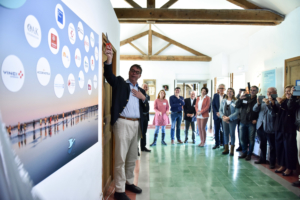
Partnerships – keys to our activities
Providing realistic responses to issues in the Mediterranean region, promoting and implementing integrated management processes, mobilising the most pertinent expertise, and funding projects. All our activities require the development of strategic relations with various organisations. Today, we conduct our activities in synergy with more than 300 partners throughout the Mediterranean Basin (research centres, NGOs, governmental or supra-governmental organisations, and foundations). Establishing these solid partnerships is indispensable for achieving our objectives, and we wish to thank all of our partners [1] and financial backers, [2]including the following:
Our main public partners
Our private partners & sponsors
The Tour du Valat has created links with numerous financial partners at various levels, including the following:
Associations & ONG
 |
The ADENA, supports supports the Mediterranean coastal reedbeds, to help managers monitor the proper functioning of reedbeds on a coherent and functional scale. |
 |
Birdlife international, supports the Illegal Killing project, which involves monitoring illegal hunting activities during waterbird counts, in order to assess the pressure exerted on these species in wetlands in eight Mediterranean countries. Analysis of the policies and legislation in force will also enable advocacy and communication to be adapted, with the aim of reducing illegal hunting by 50% by 2030. |
 |
The Conservatoire d’espaces naturels Occitanie has been supporting the monitoring of colonial shorebirds along the French Mediterranean coast since 2011 as part of the LARIMED project (2019-2025). |
 |
The new crowdfunding platform “flamingo.eco”, which supports wetlands, successfully launched its first campaign in 2025 to raise funds for a Tour du Valat project aimed at preserving the damselfly species Lestes macrostigma. Its goal is to recreate the ecological conditions necessary for the reproduction of this species. |
 |
International Crane Foundation supports the AEWA African Initiative by funding waterbird censuses in Chad and Sudan. |
 |
The LPO supports the writing of a report of lessons learned from wetland management efforts aimed at protecting the Eurasian Bittern in Europe, which will support the implementation of the 2025-2034 National Action Plan for the species. |
 |
As part of a partnership on wetlands restoration in mainland France, WWF France supports several field projects in the Camargue: restoration of agricultural wasteland at the Cassaïre and Petite Forêt sites; restoration of wetlands for the conservation of the large-stigma damselfly and other threatened dragonflies, and evaluation of projects to restore intra-lagoon hydro-ecological continuity with the European eel, an emblematic and threatened species. |
Companies
 |
AccorHotels has been a partner of the Mediterranean Lagoons Transfer Unit since 2004. It helps the MLTU celebrate World Wetlands Day and supports its communication campaign that promotes events in Mediterranean lagoon territories. Every year, its employees also take part in a wetlands enhancement project. |
 |
Bisson supports agroecology in the Camargue by purchasing birdhouses as part of the CAM-AGRO-ECO project, which promotes practices that support biodiversity. |
Foundations
 |
The Fondation Crédit Mutuel supports a project to restore wetlands in the Camargue (temporary ponds), with the aim of re-establishing favourable conditions for the reproduction of a species of odonate threatened with extinction endangered in France and Europe, Lestes macrostigma. |
 |
In line with its commitment to the conservation of wildlife and their habitats, the François Sommer Foundation supports the Tour du Valat in conducting scientific research aimed at evaluating the effectiveness of restoration and water management efforts in temporary brackish habitats. |
 |
The Fondation de France has supported several multidisciplinary research projects at the Tour du Valat. A current project, applied to agricultural production systems, aims to develop an agro-ecology showcase site on the Petit Saint-Jean farm in the Camargue Gardoise, and in particular a collective composting unit. |
  |
Terre de liens and Léa Nature / Jardin BiO foundations support a project to introduce chiropterans (bats) to our agroecological farm, as a crop auxiliaries to combat grape worms. |
 |
LUMA ARLES supports us through a project to host international students, where we raise their awareness of the challenges and consequences of climate change, and of the concept of nature-based solutions. In 2025, Luma partnered with the Tour du Valat to organise the National Forum on Research and Management of Wetlands. |
 |
The Lemarchand Foundation supports the Mediterranean lagoons transfert unit by providing key players with the tools they need to better assess the state of conservation of the lagoons as well as by raising awareness of the issues and increasing the political will to preserve them more effectively. |
 |
Since the Mediterranean Wetlands Observatory was set up, the foundation has been helping the Tour du Valat to assess the state and trends of wetlands in the Mediterranean basin, in particular by developing indicators on water resources and biodiversity. |
GET INVOLVED WITH OUR TEAM
YOUR CONTACT: Béatrice GUENEBEAUD [3], Corporate Sponsorships Officer
PHONE: + 33 (0)4 90 97 28 77 / (0)6 84 51 00 96
E-MAIL: [email protected] [4]
Our scientific and technical partners
The Tour du Valat Foundation has always worked closely with numerous scientific partners, both locally and nationally, and throughout the Mediterranean basin. Founded on the values of scientific independence, transparency and commitment to the common good, the Tour du Valat works to strengthen international cooperation in order to protect wetlands.
In France
Association des Amis des Marais du Vigueirat • CEFE • CNRS • CBNM (Conservatoire Botanique National Méditerranéen) • Conservatoire d’espaces naturels (CEN) Occitanie • EPHE Jussieu • Fondation de Recherche pour la Biodiversité • Groupe national Silure glane • Ifremer • Ifremer Corse • Ifremer Toulon • INRAe • Institut Agro • LPO (Ligue pour la Protection des Oiseaux) • Ministère de la transition écologique • Muséum National d’Histoire Naturelle • OFB (Office français de la biodiversité) • Office pour les insectes et leur environnement • Parc naturel régional de Camargue • Plant Health Institute of Montpellier • Réseau RENEDA • Réseau restauration écologique (REI) INRAE • Seaboost (EGIS) • Shape-Med@Lyon • Société Nationale de Protection de la Nature (SNPN) • UMS PatriNat/ MNHN • Université d’Aix-Marseille • Université de Clermont Auvergne • Université d’Avignon • Université de Besançon • Université de Corse • Université de la Rochelle • Université Rennes 2 • Université de Grenoble Alpes • Université Lyon 1 • Université de Montpellier • Université de Lorraine • …
Internationally
Aarhus University (Danemark) • AEWA (Allemagne) • Centre de Recerca Ecològica i Aplicacions Forestals (Espagne) • Czech university of life science Prague (Tchéquie) • Danish Hunters’ Association (Danemark) • Deltares (Pays-Bas) • DHI group (Danemark) • Ecologic Institute (Allemagne) • EURECAT (Espagne) • Faculty of Applied Ecology, Agricultural Science and Biotechnology (Norvège) • Finnish Museum of Natural History (Finlande) • GeoVille (Autriche) • Greek Biotope / Wetland Centre (ΕΚΒΥ) (Greece) • Helmholtz Centre for Environmental Research GmbH (Allemagne) • International Institute for Applied Systems Analysis (Autriche) • Katholieke Universiteit Leuven (Belgique) • LifeWatch Eric (Italie) • Mediterranean Sea and Coast Foundation (Italie) • National Research Council (Italie) • Norwegian Institute for Nature Research (Norvège) • Ramsar (Suisse) • Remote Sensing Solutions (Allemagne) • Swiss Ornithological Institute (Suisse) • Taras Shevchenko National University of Kyiv, Institute of Biology and Medicine (Ukraine) • The Royal Society for the Conservation of Nature (Jordanie) • The Swedish University of Agricultural Sciences (Suède) • University Court of the University of St Andrews (Royaume-Uni) • Universitat Politècnica de Catalunya (Espagne) • Université d’Annaba (Algérie) • Université d’Aveiro (Portugal) • Université de Batna (Algérie) • Université de Catane (Italie) • Université de Groningen (Pays-Bas) • Université de Turku (Finlande) • Université d’Ege (Turquie) • Université Miguel Hernandez (Espagne) • Université Ondokuz Mayis (Turquie) • University of Barcelona (Espagne) • University of Bucharest (Roumanie) • University of Klaipeda (Lithuanie) • University of Malaga (Espagne) • University of Naples Federico II (Italie) • University of Salento (Italie) • University of Sofia (Bulgarie) • University of Valencia (Espagne) • University of Venice (Italie) • Univesité de Bucharest (Roumanie) • Wageningen University & Research (Pays-Bas) • WasserCluster Lunz (Autriche) • Wetlands International European Association (Pays-Bas) • Union internationale pour la conservation de la nature (UICN) • …
Partner organisations based on site
The Tour du Valat also hosts five partner organisations on its site:
 |
L’Office Français de la BiodiversitéEtablissement public de 2800 agents, l’OFB vise à la protection et la restauration de la biodiversité de l’hexagone et des outre-mer. Les bureaux de l’OFB à la Tour du Valat hébergent deux Unités de la Direction de la Recherche et de l’Expertise, l’une dédiée à la petite faune sédentaire et l’autre à l’avifaune migratrice. Elles ont pour mission la connaissance, la recherche et l’expertise sur les espèces, les milieux et leurs usages. En savoir plus [5] |
|
|
L’association TakhÀ partir de la sauvegarde et l’étude du cheval de Przewalski en tant qu’espèce emblématique, l’association TAKH s’est donnée pour but de mener un projet pilote de conservation intégrée qui allie restauration de la steppe et des zones humides, protection d’espèces menacées et promotion d’un développement durable sur le site de Khomyn Tal en Mongolie. En savoir plus [6] |
 |
Le Secrétariat MedWetL’initiative pour les zones humides méditerranéennes (MedWet), qui réunit 26 pays du bassin méditerranéen et la Palestine, a pour but d’inciter ses membres à appliquer concrètement la Convention de Ramsar dans la région. Depuis 1992, MedWet favorise la mise en place de partenariats pour la conservation et l’utilisation rationnelle des zones humides. À l’invitation du gouvernement français et avec l’appui de la Fondation MAVA et de l’agence de l’eau Rhône Méditerranée Corse, le secrétariat MedWet a été relocalisé en 2014 à la Tour du Valat, où il travaille en étroite collaboration avec l’Observatoire des Zones Humides Méditerranéennes. En savoir plus [7] |