- On Tuesday 5 May 2026, over 75 actors from hunting, protected area management and research sectors gathered to discuss hunting issues and the management of waterbird populations in the Camargue.
- Aerial surveys of waterbirds during the most recent wintering season (2025–2026) recorded 103,330 ducks and coots, a figure below the average for recent years.
- The Camargue remains the most important national site for many species of wintering ducks in France, and is of international importance for 14 species of waterbirds.
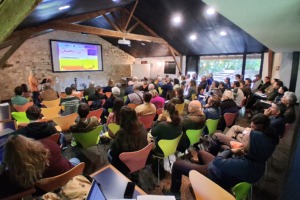
Every year since 2007, the Tour du Valat and the French Office for Biodiversity (OFB) [1] have brought together people involved in hunting, protected area management and research in the Camargue for a half-day of discussions. This year’s meeting took place at the Tour du Valat on Tuesday 5 May, attended by over 75 participants. This annual meeting aims to encourage interaction between the various stakeholders in the region on issues relating to hunting and the management of waterbird populations and their habitats in the Camargue.
The first aerial counts of Anatidae wintering in the Camargue were initiated in 1955, with the aim of continuing them over the long term in order to analyse population trends based on a standardised protocol. Jean-Baptiste Mouronval, commissioned by the Tour du Valat and the OFB to carry out the aerial counts, presented the results of the waterbird counts from the most recent winter of 2025–2026:
- 103,330 Anatidae and coots were recorded in January 2026, which is 13,000 fewer birds than the average for the last ten years.
- The winter of 2025–2026 was characterised by numbers above the average for the past 10 years in November, but these declined from December onwards for the Mallard, the Common Teal and the Gadwall due to excessively high water levels following heavy winter rainfall.
- For the same reason, numerous flooded agricultural plots hosted substantial numbers of Greater Flamingos, Common Shelducks and Glossy Ibis, whilst the very high water levels in the marshes and lagoons caused waders to abandon the area, notably Pied avocet, whose numbers fell to less than 1,000 individuals in January compared with nearly 3,300 in December.
- Seasonal numbers were good for Northern Shovellers, Northern Pintail and Shelducks; modest and declining for Eurasian wigeons and Red-crested Pochard. Despite a sharp decline in recent years, numbers of Common Pochards and Greylag Geese were less low than expected this season.
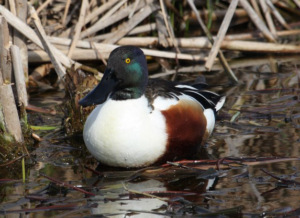
Although the lakes and ponds of the Champagne humide region are becoming increasingly important along the migration corridor, particularly at the start of the wintering season, the Camargue remains the most important national site for many species of wintering ducks in France, and is of international importance for 14 species of waterbirds: Mute Swan, Eurasian teal, Mallard, Northern Shoveler, Gadwall, Red-crested Pochard, Greater Flamingo, Spoonbill, Glossy Ibis, Common Crane, Pied Avocet, Dunlin and Common Shelduck.
During this morning’s discussion session, Jean-Baptiste Mouronval and Lina Lopez-Ricaurte, associate researcher at the Tour du Valat, went on to present, respectively, the National Management Plan for meadow waders and the use of the Camargue by Black-Tailed Godwits. Marie-Claude Serra, project officer at the Conservatoire du Littoral PACA, then outlined the hunting activities carried out on the Conservatoire du Littoral’s sites in the Camargue. A review of the management of avian influenza outbreaks in 2025–2026 was presented by Marion Vittecoq, coordinator of the Health Ecology theme at the Tour du Valat. Finally, Claire Tétrel, conservationist at the Grandes Cabanes Sud, presented the results of the COLAGANG project (2021–2025) on ecological connectivity between lagoons and the study of European eel migration in the Rhône delta.
| Anyone interested in receiving the monthly summaries of wintering duck counts in the Camargue and keeping up to date with upcoming meetings can send an email to Fanny BOMPARD at [email protected] [2]. |