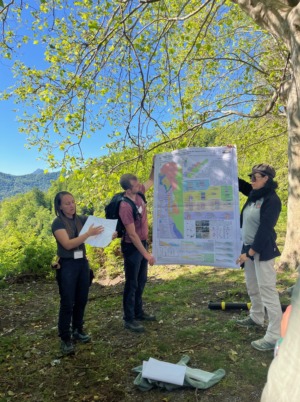
In May 2026, Columba Martinez Espinosa, a research engineer with the Flux Admissibles (FA) mission – led by the Tour du Valat, Ifremer and the Rhône-Méditerranée-Corse Water Agency – took part in two complementary key events in Corsica and Sardinia. A training course in hydrogeology in Corte, followed by the International Nitrogen Workshop in Sassari, enabled her to both strengthen the technical skills required by the Mission and consolidate her connections with the scientific community working on nitrogen fluxes across the Mediterranean, in collaboration with agricultural stakeholders, researchers and European decision-makers.
| Finding the right balance between nutrient inputs and lagoon health
Since 2021, the FA mission, has been supporting the implementation of an approach aimed at better regulating nutrient inputs into French Mediterranean lagoons, with a view to restoring ecological balance, understanding the processes underlying their degradation, and proposing measures to support their recovery. In concrete terms, it aims to determine the dynamics of nitrogen and phosphorous loads that lagoons can absorb. depending on site-specific and climatic conditions, as well as to understand how these nutrients are utilised by the various biological compartments, particularly primary producers, in order to identify assimilation thresholds compatible with sustaining ecosystem functioning. These inputs stem mainly from agricultural activities, urban discharges, one-off events such as floods and dam releases, as well as runoff. To this end, the FA mission provides technical and scientific expertise to local stakeholders: defining sampling strategies, selecting calculation methods and supporting measurement systems to quantify nutrient fluxes. It also employs lagoon modelling via the GAMELag tool (‘Management and planning of Eutrophic Lagoon Environments’), which enables the simulation of lagoon dynamics and evaluation of different management scenarios. By combining field measurements and modelling, the FA mission helps to identify concrete actions to reduce excess nutrients and maintain or restore the good ecological status of Mediterranean lagoons. |
Corsica Training (Corte, 17–23 May 2026)
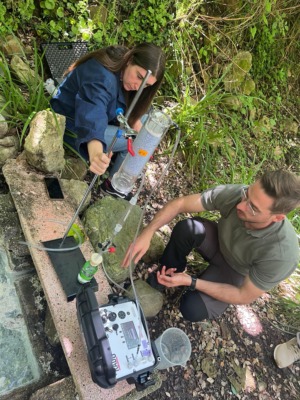
In Corte, a five-day intensive course on hydrogeology in the Mediterranean region provided an in-depth understanding of how coastal aquifers function. In particular, it explained how water flows in the subsurface, from catchment areas to springs and boreholes, as well as the methods used to study and analyse them in the field.
Led by teachers and researchers from the universities of Corsica and Pisa, the course alternated between theoretical sessions, field trips and practical work in two contrasting catchment areas, ranging from mountainous terrain to coastal lagoon environments. Participants collected physico-chemical data, used geochemical and isotopic tracers, and developed conceptual hydrogeological models to better understand groundwater system functioning. This work highlighted the exchanges between rock and water, the interactions between the surface and the subsurface, and the role of coastal aquifers in supplying the lagoons.
Acquiring these new skills will improve the representation of groundwater flow in the GAMELag model and enable hydrogeological factors to be incorporated in greater detail from Phase I onwards at the FA mission’s study sites, in order to better quantify the nitrogen (N) and phosphorus (P) fluxes reaching the lagoons.
A session dedicated to wetland hydrology, illustrated by the case of the Biguglia lagoon south of Bastia, has also opened up prospects for collaboration with CNRS UMR 6134 SPE.
N-Workshop in Sassari (Sardinia, 24–30 May 2026)
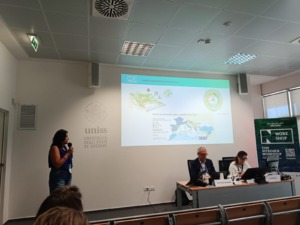
In Sassari, participation in the Nitrogen Workshop, funded by the OurMED project, provided an opportunity to present the FA mission to an international community of experts specialising in nitrogen fluxes, at the intersection of water, energy and food nexus.
One of the main themes addressed was the quantification of N₂O (nitrous oxide) emissions linked to agricultural practices and the optimisation of fertiliser use and irrigation. A dedicated day was devoted to discussions with European decision-makers involved in the implementation of the Nitrates Directive.
In this context, the FA Mission shed further light on the eutrophication of lagoons, a phenomenon that is still often under-represented in nitrogen balances. In particular, it highlighted the central role of wetlands in nutrient pathways and the impacts of the agro-industry on lagoon ecosystem, while showcasing a successful example of cooperation among scientists, managers, local stakeholders and institutions.
A field day was devoted to the Arborea ‘living lab’. This agricultural plain, created by the drainage of former marshes and now heavily irrigated, is classified as a nitrate-vulnerable zone. It comprises more than 200 dairy farms and around 30,000 head of cattle across 6,000 hectares.
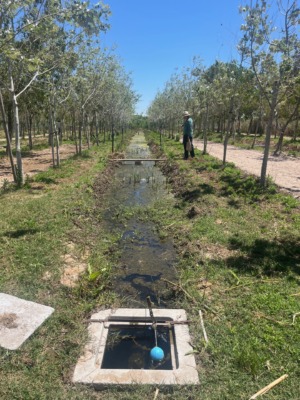
This site provides a concrete illustration of the effects of intensive farming on water resources: massive inputs of nitrogen and phosphorus, combined with highly permeable sandy soils, lead to high concentrations of nitrates in groundwater and to the eutrophication of the surrounding wetlands and lagoons classified as Ramsar sites.
The visit provided an opportunity for direct on-site discussion regarding the tensions between environmental requirements (the Nitrates Directive), the economic viability of the dairy sector and the objectives of restoring natural habitats. It also highlighted solutions that have been piloted to reduce nitrogen leaching into groundwater and lagoon ecosystems, in line with the issues addressed by the FA Mission in the French Mediterranean.
Contributions to the Tour du Valat and the FA Mission
By combining methodological reinforcement in hydrogeology with exchanges with the scientific community working on nitrogen, these two meetings help to improve the technical aspects of the FA Mission and to promote its results with a view to reducing eutrophication in Mediterranean lagoons.
The two events proved highly complementary: the training course in Corsica provides a solid foundation for better understanding and modelling subsurface nutrient flows, whilst broadening collaborations, strengthening hydrogeological expertise, and deepening the integrated understanding of catchment areas functioning. The workshop in Sardinia, meanwhile, provides an opportunity to observe in the field the consequences of nitrate-contaminated groundwater on a complex agricultural socio-ecosystem, as well as the efforts being made to restore a lagoon. In this context, although the FA Mission is based on highly technical work, it addresses an issue common to many contexts across the Mediterranean: eutrophication. As such, this mission provides concrete support to the Observatory’s team and helps to position the Tour du Valat as a leading institution on this issue, whose expertise can be drawn upon by its partners and other teams.
Contact:
Columba Martinez Espinosa [1], Tour du Valat, [email protected] [2]